

































Coat Mite Dog Recognise and Treat: Tips for Owners
 by Nicolas Bartholomeeusen on Jun 14 2026· 7 min read
Key takeaways
- Watch for scaly, flaky skin, a dull coat, hair loss and itching that can escalate to bald patches and thickened skin on the ears and back.
- Vets confirm mange through microscopic hair and skin flake checks, skin scrapings, or the adhesive tape method, sometimes starting treatment early if suspicion is strong.
- Spot-on treatments like selamectin or moxidectin, anti-parasite shampoos and, in stubborn cases, oral ivermectin tablets are the most effective options, and every pet in the household needs treating even without symptoms.
- Clearing an infestation for good means washing bedding at 60 degrees Celsius, vacuuming thoroughly and using environmental sprays, since natural remedies such as diatomaceous earth or neem oil are not a guaranteed substitute for veterinary care.
Do you want to recognise and treat coat mites in your dog? The most common cause is Demodex canis, the mite behind demodectic mange. It causes flaky skin, itching and hair loss, and it lives quietly in every dog's hair follicles from birth, only turning into a problem once the immune system loses its grip on it. In this article, you'll discover how to recognise the symptoms of demodectic mange, what treatment actually works, and how to stop your dog from getting reinfected. We'll also look at whether the natural remedies people swear by hold up, and clear up a mix-up that trips up a lot of pet owners.
Good to know
"Coat mites" usually means one of two different conditions: demodectic mange (caused by Demodex canis) or cheyletiellosis, also called walking dandruff (caused by Cheyletiella). They can look similar on a scruffy, itchy dog, but they behave very differently. Demodex is a normal resident of a dog's skin and isn't caught from other animals. Cheyletiella spreads easily between animals, and to people too. This article focuses on demodectic mange, the more common of the two.
How do you recognise demodex mites in dogs?
Mange causes characteristic skin problems in your dog. The most common symptoms are:
- Scaly skin (‘dandruff’), visible as white flakes on the coat.
- A dull coat and excessive hair loss.
- Itching, ranging from mild to intense, where scratching can cause bald patches.
- Thickening of the skin, particularly on the ears and back.
- Scab formation, particularly in persistent infections.
Some dogs show only mild symptoms. Others develop severe irritation that needs a vet's attention fast.
Which dogs are most at risk of coat mites?
Demodectic mange is more common in:
- Young puppies and dogs with a weakened or compromised immune system, since the mite overgrows once immune control slips.
- Certain breeds, including American Staffordshire terriers, Staffordshire bull terriers and Shar Peis, which show a higher rate of juvenile-onset generalized demodicosis.
- Dogs with an underlying illness or on immune-suppressing medication, which are common triggers for adult-onset cases.
It's not a rare problem. A five-year survey of more than a thousand dogs in Taipei found Demodex canis in 7.2% of samples overall, with a clear seasonal pattern: prevalence climbed to 12.5% in winter months [1].
How is demodectic mange diagnosed in a dog?
A veterinarian makes the diagnosis using specific techniques:
- Microscopic examination of loose hairs and skin flakes to identify demodex mites or eggs.
- Skin scrapings, in which small samples of skin are analysed for mites and their faeces.
- Adhesive tape method, in which a transparent tape is pressed onto the skin and examined under a microscope.
If there is strong suspicion, a veterinarian may start preventive treatment, even if the mites are not immediately found.
How do you treat fur mites in a dog?
Fur mite infestations require targeted medical treatment and a thorough cleaning of the environment. Skipping either half of that usually means treating the same dog twice.
Which medicines help against demodectic mites?
The most effective treatments are:
- Spot-on treatments such as selamectin or moxidectin (applied monthly to the back of the neck).
- Special anti-parasite shampoos to thoroughly wash the coat and skin.
- Oral tablets such as ivermectin, or newer isoxazoline chewables like afoxolaner, prescribed by a veterinarian for stubborn cases.
The numbers back this up. In a European field study, monthly topical moxidectin cleared mites from 87.5% of dogs by day 84, while a single dose of the newer isoxazoline fluralaner reached 98% [2]. A separate trial of oral afoxolaner found mite counts dropped by 87.6%, 96.5% and 98.1% at days 28, 56 and 84 [3]. Whichever option your vet picks, the pattern is the same: it takes weeks, not days, to see it through.
How often should you repeat the treatment?
To eradicate all mites and new larvae:
- Spot-on products: repeat every 4 weeks until the infection has cleared.
- Shampoos: use weekly for at least 4 to 6 weeks.
- Tablets: depending on the schedule prescribed by the veterinarian.
Do other pets in the house need treatment too?
Not for Demodex. It's host-specific, so a case of demodectic mange in your dog won't jump to the cat, the rabbit or another dog in the house, and pets without symptoms don't need treating. The exception is if a vet diagnoses Cheyletiella instead: that mite does move between species, so treating every animal in the household becomes worthwhile.
How can you treat and prevent mange at home?
In addition to medication, thorough cleaning of the environment is essential to prevent re-infestation.
How do you clean your home after an infestation?
- Wash bed linen, blankets and pillows at a minimum of 60°C.
- Vacuum floors, sofas and carpets, then dispose of the vacuum cleaner bag.
- Use environmental sprays against mites on fabric surfaces such as sofas and baskets.
How can you prevent infestation in the future?
- Keep up with routine parasite prevention and regular vet checkups. A dog's immune system is the real gatekeeper against demodectic mange flaring up again.
- Clean dog brushes and toys regularly.
- Avoid contact with visibly infested animals during walks or at kennels. This mainly guards against Cheyletiella, the contagious one.
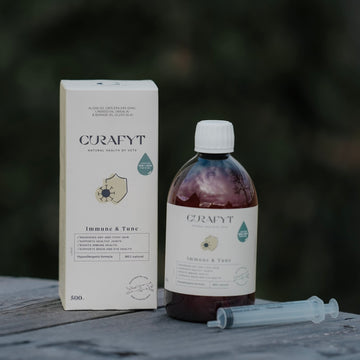
IMBY Immune & Tune Supplement
Formulated to support both a dog's immune system and healthy skin, which lines up with the point above: demodectic mange only takes hold once immune control slips.
Are there any natural remedies for coat mites?
Some home remedies get mentioned often, but none offer a guaranteed cure. A few commonly used natural options:
- Diatomaceous earth (silica), a natural powder that dehydrates mites.
- Neem oil, which may have a repellent effect against parasites.
- Essential oils such as lavender or tea tree (use with caution, as some are toxic to dogs).
Good to know
Natural treatments often fail to kill every mite and egg in one pass, so a relapse a few weeks later is common if you rely on them alone. Use them alongside veterinary treatment, not instead of it, and check with your vet first.
Can people catch coat mites from their dog?
Demodex is not considered contagious between dogs, and it isn't a recognised zoonotic risk either, so a dog with demodectic mange isn't a mite risk to the household. Cheyletiella is the one to watch: it's a well-documented zoonosis, and case reports describe owners developing itchy red bumps on the arms, chest or abdomen after handling an infested pet [4].
- These symptoms tend to clear on their own, usually once the animal is treated and the environment cleaned.
- People generally don't need medical treatment for it, though a rash that lingers is worth mentioning to a doctor.
Conclusion
Demodectic mange causes itching, flaky skin and hair loss, and it needs a full course of treatment to avoid a relapse. Spot-on treatments, shampoos and tablets all work, provided they're used correctly and for long enough. Cleaning the environment matters too: wash bedding at 60°C and keep vacuuming. Natural remedies can support the process, but they're not a substitute for medication. Get the diagnosis right first, since demodectic mange and cheyletiellosis are treated differently, and follow the full course even after the itching stops.
References
[1] Tsai Y-J, Chung W-C, Wang L-C, et al. The Dog Mite, Demodex canis: Prevalence, Fungal Co-Infection, Reactions to Light, and Hair Follicle Apoptosis. Journal of Insect Science. 2011;11:76. doi:10.1673/031.011.7601
[2] Petersen I, et al. A European field assessment of the efficacy of fluralaner (Bravecto) chewable and spot-on formulations for treatment of dogs with generalized demodicosis. Parasites & Vectors. 2020;13:304. doi:10.1186/s13071-020-04159-2
[3] Lebon W, Beccati M, Bourdeau P, et al. Efficacy of two formulations of afoxolaner (NexGard and NexGard Spectra) for the treatment of generalised demodicosis in dogs, in veterinary dermatology referral centers in Europe. Parasites & Vectors. 2018;11:506. doi:10.1186/s13071-018-3083-2
[4] Wagner R, Stallmeister N. Cheyletiella dermatitis in humans, dogs and cats. British Journal of Dermatology. 2000;143(5):1110-1112. doi:10.1046/j.1365-2133.2000.03869.x
Support your dog's skin from the inside too
Treating mites is a vet's job, but what your dog eats plays a part in how the coat recovers afterwards. IMBY's GI Sensitive Dog Food is a hypoallergenic, insect-based recipe with flaxseed and sunflower oil for skin support, built for dogs whose skin flares up alongside digestive issues.
View IMBY GI Sensitive Dog FoodShare