


★★★★★
Rudi B.
"We've been using this product for 3 months now to treat our doodle's itching. Results are surprisingly positive. Itching is much reduced and the skin looks much calmer too."

Quick view
A Veterinarian's Honest Verdict
A 3-minute read on what's actually behind chronic itching in dogs, and which ingredients have real evidence behind them.

Valérie trained and qualified as a veterinarian before founding Curafyt, a Belgium-based supplement company built around the idea that pet supplements should be held to the same evidence standard as anything else recommended in a clinic. She works directly with dog and horse owners, and with Curafyt's product team, on nutrition and skin, gut, and joint health.

Chronic itching is one of the most common reasons dogs are brought in for care. But the skin is usually where an upstream problem shows up, not where it actually starts.
If you've ever sat with a dog that won't stop scratching, you're not alone. Itchy, irritated skin is one of the most common reasons dogs are brought in for veterinary care, and after years of seeing it in practice, I can tell you most owners have had enough.
A flea comb, a steroid shot, or a course of antihistamines can be exactly the right call for a flare-up, and I'd always advise speaking to your vet if you are concerned.
Owners come to me convinced their dog has a “skin problem.” Most of the time, the skin is just where the problem shows up. The actual issue is usually upstream, in the gut, in the immune system, or in how reactive the body has become to things in the environment.
That distinction matters more than it sounds. It's the difference between managing a symptom for life and actually giving the skin barrier a chance to do its job.

Canine atopic dermatitis is a chronic inflammatory skin condition. The immune system overreacts to things that shouldn't trigger a reaction at all — things like pollen, dust mites, or certain proteins — and the skin is simply where that overreaction becomes visible.
That's why a dog can be itching at the paws, ears, belly, and base of the tail all at once, with no obvious external cause. The trigger isn't on the skin. It's in the immune response underneath it.
There's also a piece most owners never hear about: the gut. A disrupted gut barrier and microbiome are linked to the same overactive immune responses that drive allergic skin disease. That's why dogs with itchy skin so often also have sensitive digestion or soft stools. I see this pairing constantly in practice. It's rarely a coincidence.
This is where most dog supplements lose me fast. They list fifteen “skin-supporting” ingredients on the label and call it a day. What matters to me is which of those ingredients have actual evidence behind them in dogs, not just a plausible story.
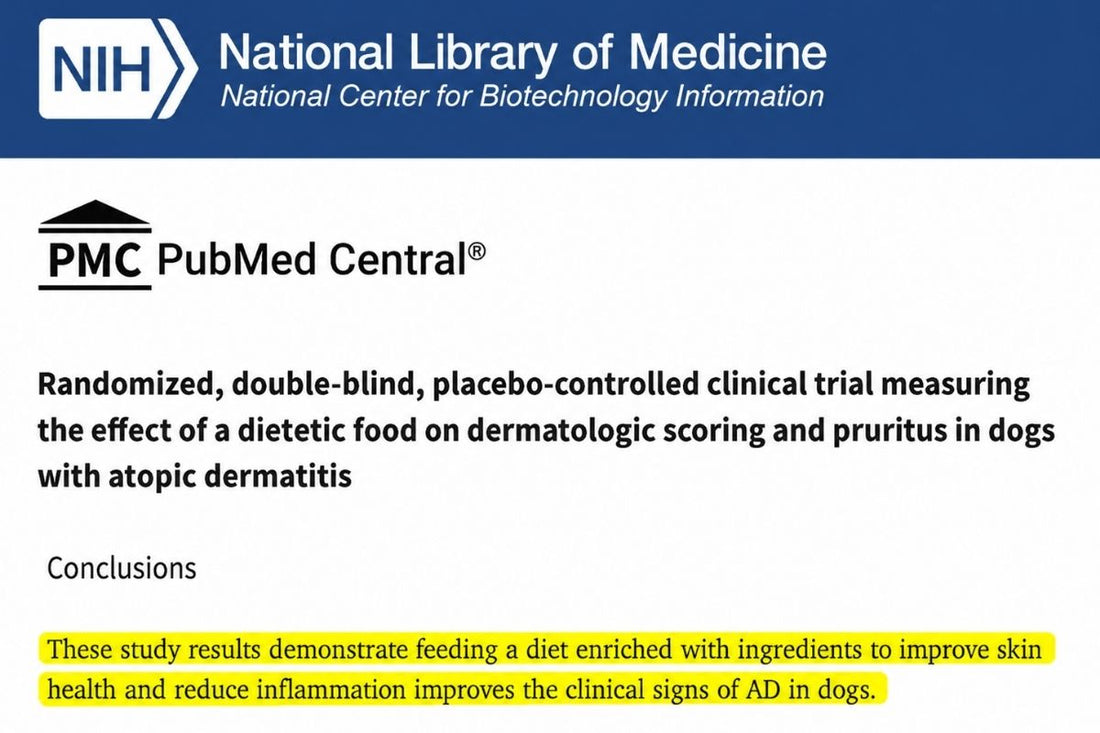
Omega-3s (EPA and DHA) have the strongest evidence of anything we have nutritionally for itchy skin. In a controlled trial, dogs with atopic dermatitis fed a diet enriched in EPA, DHA, and antioxidants for two months showed real, measurable improvement in their skin scores. This is exactly the kind of nutritional support that belongs alongside a vet's care plan — supporting the skin barrier from the inside while your vet manages the bigger picture.
Quercetin is one of the ingredients I get asked about most. It's a plant compound with genuine antioxidant properties, and early lab studies on immune cells are encouraging, showing it can dampen the kind of histamine release that drives itching. The research in dogs specifically is still developing, so I treat it as a supporting player rather than the headline act. Alongside the other ingredients in the formula, it adds another layer to how the skin handles everyday irritation.
The gut-skin link has real grounding. L-glutamine helps fuel the cells lining the gut wall. Probiotics and colostrum support a more balanced immune response. None of this is a guess. It's why a “skin” formula that ignores the gut is only solving half the problem.
The honest version
Fish oil has the most robust evidence behind it for itchy skin specifically, and ingredients like quercetin, colostrum, probiotics, and glutamine each bring real, complementary support to the gut-immune-skin connection. It's the combination that does the work, not any single ingredient acting alone.
IMBY Allergy & Itch is built around this same logic: support the skin, the gut, and the immune system at the same time, rather than masking the itch from the outside. It works through four connected pathways.

L-glutamine to help support the intestinal wall, since gut integrity and skin reactivity are closely linked.
Probiotic strains to support a healthier, more balanced gut environment.
Colostrum, echinacea, and postbiotics to support a more measured immune response.
Quercetin, sophora, and vitamin E to support the skin's normal response to irritation, alongside DHA-rich algae oil.
It's not a fast fix, and I won't pretend otherwise. Anyone who does is just lying to you. In the dogs I see on a daily routine like this, the pattern tends to look like this.
If an owner expects this to work in three days, they'll be disappointed and they'll stop. If they understand it's rebuilding something, six to twelve weeks of consistent use is realistic — and that's backed by how long it actually takes omega-3s to build into skin cell membranes.

Support the skin, gut and immune system together — the way the science actually points.
★★★★★ Verified reviews, collected by Curafyt
★★★★★
"We've been using this product for 3 months now to treat our doodle's itching. Results are surprisingly positive. Itching is much reduced and the skin looks much calmer too."
★★★★★
"We've been giving this supplement for 3 months now, 3 treats a day, and our dog is now completely free of his itching. After a long and miserable search, we've finally found the right product."
★★★★★
"We've been giving our severely allergic Basset Hound this supplement for about a month. After about 2 weeks the itching was gone. We're over the moon."
★★★★★
"We have 2 French Bulldogs, one with severe allergic complaints. Since using this supplement, he's completely stopped scratching. Both our dogs now get this as their daily reward treat."
This kind of formula tends to make the most sense for:
Chronic itching can have several underlying causes, so if you haven't already worked out what's driving it, it's worth getting that confirmed first. This is a daily nutritional layer for ongoing skin and gut support, not a quick fix for a flare-up you don't understand yet.
Formula
IMBY Allergy & Itch is made without fillers or artificial binders. The full ingredient panel is listed on the product page, with the reasoning behind each one.
Omega-3s have the strongest evidence of anything we have nutritionally for itchy skin. DHA-rich algae oil helps rebuild the skin barrier from the inside out.
Helps fuel the cells lining the gut wall, supporting the gut barrier that's closely linked to skin reactivity.
Supports a more balanced immune response, working alongside the gut-immune-skin connection.
A plant compound with antioxidant properties that can help dampen the histamine release behind itching.
Probiotic strains that support a healthier, more balanced gut environment.
A source of fatty acids that build into skin cell membranes over time, supporting long-term skin comfort.
An essential trace mineral that supports normal skin structure and immune function.
An antioxidant that helps protect skin cells from everyday oxidative stress.
Traditional botanicals included to support the skin's normal response to irritation.
If your dog's skin issues come and go with the seasons, or scratching has become part of the daily routine, give a gut-immune-skin formula the six to twelve weeks it actually needs to do something.
One vet-developed formula that works the skin, gut and immune system together. Subscribe and save 15% — free shipping, no contract, cancel anytime.
A daily reward treat for ongoing skin & gut support · 10% off every recurring order
Curafyt offers a subscription option with 10% off every recurring order and free shipping — useful given the timeline above means most dogs are on it for at least two to three months before owners see the full effect.
Overview of skin disease prevalence as a reason for veterinary visits — canine dermatology caseload. ukvetcompanionanimal.com
Th2-driven mechanism in canine atopic dermatitis; periostin biomarker literature. PMC12477772
Beynen AC, 2020. “Quercetin for dogs” — critical review on the quercetin evidence gap in dogs. Bonny Canteen 2020;1:30–37.
Witzel-Rollins et al. Randomized, double-blind, placebo-controlled trial of an EPA/DHA/antioxidant/polyphenol diet in canine AD (CADESI-4). PMC8603501
Schäfer L, Thom N, et al., 2024. PUFA supplementation reducing oclacitinib dose requirement in atopic dogs. Veterinary Dermatology 35:408–417. doi:10.1111/vde.13246
Saevik BK, Bergvall K, Holm BR, et al., 2004. Steroid-sparing effect of EFA supplementation in canine AD. Veterinary Dermatology 15(3):137–145. doi:10.1111/j.1365-3164.2004.00378.x
Mueller RS, Fieseler KV, Fettman MJ, et al., 2004. Omega-3 fatty acids and canine atopic dermatitis (RCT). Journal of Small Animal Practice 45:293–297. doi:10.1111/j.1748-5827.2004.tb00238.x
This article is for general informational purposes. If your dog is showing signs of skin irritation, itching, or allergy, it's worth getting the cause confirmed with your vet before starting a daily routine to manage it.