

What is the importance of taurine in cat food?
 by Nicolas Bartholomeeusen on Jun 14 2026· 5 min read
Key takeaways
- Cats cannot synthesise taurine in sufficient quantities; dietary intake is their only reliable source, making taurine content in food a non-negotiable requirement.
- Dilated cardiomyopathy caused by taurine deficiency is partially reversible with supplementation; central retinal degeneration is not, making prevention the only effective strategy.
- Taurine is found only in animal-derived ingredients; plant-based diets require synthetic taurine supplementation to be nutritionally safe for cats.
- Home-prepared diets carry a higher deficiency risk than commercial complete foods; formulation by a veterinary nutritionist and regular blood taurine monitoring are both advisable.
Taurine is classified as a conditionally essential amino acid in most mammals, meaning the body can synthesise it from other amino acids. Cats cannot. Their capacity for taurine synthesis is too low to meet daily requirements, which makes dietary intake the only meaningful source. This single metabolic fact has significant consequences for how cats should be fed.
What taurine does in the body
Taurine is concentrated in several tissues where it performs specific structural and functional roles. In the heart muscle it contributes to contractility and calcium handling. In the retina it is present in high concentrations and is required for photoreceptor integrity. In the digestive system it conjugates bile acids, which are essential for fat absorption. It also plays a role in reproductive function and immune response.
Because taurine is not stored in large reserve pools and is continually lost through bile acid turnover, a consistent supply from food is necessary to maintain adequate tissue concentrations.
Consequences of taurine deficiency
The two most clinically significant consequences of taurine deficiency in cats are dilated cardiomyopathy (DCM) and central retinal degeneration.
DCM is a disease in which the heart muscle weakens and the chambers enlarge, reducing the heart's ability to pump effectively. In 1987, Pion and colleagues demonstrated that taurine-deficient cats developed DCM and that supplementation reversed the condition in the majority of affected animals [1]. This finding transformed understanding of feline nutrition and led to taurine being mandated in commercial cat food. Prior to that discovery, DCM was a leading cause of cardiac death in cats in countries where processed pet food was the primary diet.
Central retinal degeneration causes progressive, irreversible vision loss. Unlike DCM, which is at least partially reversible with supplementation, retinal damage in advanced cases cannot be fully repaired. Hayes and colleagues identified the connection between taurine depletion and retinal degeneration in cats in 1975 [2], establishing one of the earliest documented taurine deficiency syndromes in domestic animals.
Both conditions are preventable
DCM and retinal degeneration caused by taurine deficiency are entirely preventable through adequate dietary intake. They became rare after taurine supplementation became standard practice in commercial cat food. They can still occur in cats fed home-prepared diets without careful formulation.
Sources of taurine
Taurine is found exclusively in animal-derived ingredients. Muscle meat, heart, liver, and seafood are the most taurine-rich whole-food sources. Plant ingredients contain no taurine, which is why a diet based on plant protein requires synthetic taurine supplementation to be safe for cats.
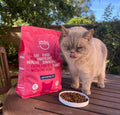
Insect meal is an increasingly researched alternative protein source. Like other animal proteins, insects naturally contain some taurine. There is an important catch, however: taurine is heat-sensitive, and the high-temperature extrusion process used to make dry kibble destroys a significant portion of whatever taurine was originally present in the raw ingredients. This is true for chicken, fish, and insects alike — which is exactly why virtually all complete commercial cat foods add taurine to the final recipe, regardless of the protein source used. The guarantee of adequacy comes from the formulation, not from the raw ingredient alone. IMBY's insect-based cat food is formulated this way: taurine is added to ensure cats get everything they need, so choosing a hypoallergenic or more sustainable option does not require any nutritional compromise.
IMBY Insect-Based Vitality Cat Food
Complete hypoallergenic cat food made with sustainable insect protein. Formulated with added taurine and developed by vets — for cats that need a novel protein without nutritional compromise.
How much taurine does a cat need?
The Association of American Feed Control Officials (AAFCO) sets minimum taurine requirements for cat food. For adult cats, the minimum is 0.1% dry matter in extruded (dry) food. Wet and canned foods require a higher minimum of 0.2% dry matter, because taurine bioavailability is lower in moist, heat-processed formats.
These minimums reflect population-level adequacy under standard manufacturing conditions. Individual cats vary in absorption efficiency, and foods with lower taurine bioavailability (such as highly processed or high-plant-protein formulations) may need to exceed the minimum to reliably meet requirements.
Home-prepared diets and raw feeding
Home-prepared diets and raw feeding carry a higher risk of taurine deficiency than commercial foods, which are formulated and tested against established requirements. Raw muscle meat contains taurine, but heat processing destroys a proportion of it; cooked home diets based on muscle meat may not supply adequate amounts without supplementation. If feeding a home-prepared diet, formulation by a veterinary nutritionist and regular monitoring of blood taurine levels is the safest approach.
FAQ
Can I tell if my cat is taurine deficient without a vet visit?
Not reliably. Early deficiency is clinically silent. By the time visible signs appear (reduced vision, breathing difficulties, exercise intolerance), significant damage has often already occurred. Routine cardiac and ophthalmic screening is more useful than waiting for symptoms.
Does feeding a high-quality dry food guarantee adequate taurine?
Commercial dry foods meeting AAFCO standards are formulated to provide adequate taurine. The risk is higher with home-prepared diets, foods that do not carry an AAFCO nutritional adequacy statement, or generic/unregulated products from markets without mandatory nutritional standards.
Are all cats at equal risk of deficiency?
No. Cats on commercial complete diets that meet AAFCO minimums are at low risk. Risk is higher for cats on home-prepared diets, cats with chronic digestive disease that impairs taurine absorption, and cats fed dog food regularly (dog food is not formulated to meet feline taurine requirements).
References
[1] Pion PD, Kittleson MD, Rogers QR, Morris JG. Myocardial failure in cats associated with low plasma taurine: a reversible cardiomyopathy. Science. 1987;237(4816):764–8.
[2] Hayes KC, Carey RE, Schmidt SY. Retinal degeneration associated with taurine deficiency in the cat. Science. 1975;188(4191):949–51.
Share