

Home
›
Expert Horse Health & Wellbeing Advice
›
Body Condition Score in Horses: How to Use It and Why Most Owners Get It Wrong

Body Condition Score in Horses: How to Use It and Why Most Owners Get It Wrong
 by Dr. Valerie De Clerck on Aug 04 2026· 8 min read
Key takeaways
- Score your horse with your hands at six sites once a month and write the number down, because a trend catches condition loss that daily observation misses.
- Most owners misjudge their own horse's condition, and research shows that being taught the system does not fix it, so pair the score with a weight tape and a monthly photo.
- Body condition scoring is least reliable at the fat end of the scale, which makes it a comparatively good tool for tracking a horse that is losing condition.
- A falling score needs teeth, worm burden and forage ruled out first, then extra energy density from oil rather than starch.
By late August the grass has stopped working as hard as it did in June. Owners notice it in small ways first. A rug that hangs differently. A shoulder that looks sharper in the evening light. Sometimes nothing at all, until a friend at the yard says "he's looking a bit ribby" and the doubt sets in.
That gap between what an owner sees and what is on the horse is the reason body condition scoring exists. The score is a number, taken with your hands, that tells you how much fat your horse is carrying. It is the single most useful thing you can learn to do for a horse whose weight moves with the seasons, and the evidence says most owners are not yet doing it well.
A short guide to scoring your horse
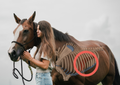
The system in use today came out of a 1983 study on mares, which linked hands-on appraisal of fat cover to measured body fat percentage and produced the 1 to 9 scale still used worldwide (Henneke et al., 1983). You score six places: the neck, behind the shoulder, over the withers, along the ribs, down the back and loin, and around the tailhead. Most riding horses sit comfortably at 4.5 to 5.5.
The rule worth remembering
You should be able to feel your horse's ribs easily, without seeing them.
Two things matter more than the exact number. Score with your hands, not your eyes, because a summer coat flatters and a winter coat hides. And write it down, on the same day each month, so you have a trend instead of an impression. A step-by-step walkthrough of each site is in our guide to assessing your horse's body condition score.
Why most owners get the number wrong
This is the uncomfortable part. When researchers compare owner scores against an expert's, agreement is poor.
An Irish study scored 60 horses and found 45% were overweight or obese. Owners scored their own horses before and after being taught the system. Accuracy stayed poor both times. The authors' conclusion was blunt: body condition scoring by owners does not produce accurate assessments of their horses' condition (Golding et al., 2023). An Italian study of owner versus veterinary scoring found only slight agreement, on body condition score and on cresty neck score, with age, breed, sex and workload all shifting the result (Busechian et al., 2022).
Teaching alone does not fix it, which tells you the problem is not really knowledge. Some of it is that fat gets read as muscle. Some of it is that a well-covered horse looks cared for, and a lean, fit horse can look neglected to an eye trained on the show ring. And some of it is simple familiarity. You see your horse every day, so slow change is close to invisible.
This cuts both ways in August. The same blind spot that lets an overweight pony stay overweight lets a hard-working or older horse quietly drop a full point before anyone acts. If you already suspect your horse has gone past lean, start with our guide on the too-thin horse.
Where the scale itself falls short
The score has real limits, and knowing them makes you better at using it.
Its accuracy is not even across the range. Working with 77 horses and ponies and measuring body fat directly, researchers found the relationship between score and actual fat was logarithmic, and that the score's power to predict body fat got weaker as the score got higher (Dugdale et al., 2012). At the top end the descriptors run out of resolution. The practical read: for a horse losing condition, the lower end of the scale where you are working is the part that behaves best.
Newer work has gone after the subjectivity directly. A 2024 study derived a body condition index from tape measurements instead of opinion, using heart girth, belly girth, neck circumference, height and body length, validated against body fat measured by deuterium dilution. It correlated well with body fat (r = 0.74) and, the useful bit, proved more consistent and repeatable in the hands of inexperienced assessors than scoring did (Potter et al., 2024). It is not perfect either. It slightly overestimates fat in leaner animals and underestimates it in obese ones, so for a thin horse it will read a touch kindly.
None of this means abandon the score. It means pair it. Hands on the six sites, a weight tape, and a photo from the same spot in the same light each month. Three cheap measures that disagree with each other are far more informative than one you trust too much.
What to do when the score starts dropping
A falling score is a symptom, not a diagnosis. Before reaching for a feed scoop, rule out the ordinary causes: teeth, worm burden, pain, and forage that looks like enough but is not. Older horses are the ones to watch now, because a September dip is much harder to reverse in November. Our vet's walkthrough of why horses lose weight covers that workup in order, and if bloods are on the table, what a blood test can reveal explains which values are worth asking for.
Once the basics are handled, the problem is usually energy density. A horse that already fills up on hay cannot eat its way to a higher score on volume alone, and piling in starch to close the gap brings its own risks. Building the ration properly comes first, and our step-by-step feeding plan for a horse that needs to gain works through it. Oil is the efficient answer. Fat carries more than twice the energy of an equivalent weight of cereal, it is slow-release rather than sugar-spiking, and a recent review of omega-3s in equine nutrition makes the point that dietary fats work as functional ingredients and not only as fuel, with roles across metabolic and inflammatory pathways (Bronś et al., 2026). That same review is honest about the state of the evidence: many equine trials are small and poorly standardised for age, sex and condition.
The coat effect is better established than most owners realise. Twenty-four horses supplemented with plant-based omega-3 oils for 16 weeks showed measurably more omega-3 in their actual skin tissue within 8 weeks, and a lower omega-6 to omega-3 ratio (Hartwig et al., 2025). The dull, staring coat that travels with a dropping condition score has a nutritional component, and it responds.
Grow & Glow
A cold-pressed oil blend of linseed, coconut and lecithin with DHA-rich microalgae oil at 1500 mg DHA per 100 ml, plus natural vitamin E. For a 500 kg horse that is 100 ml a day over the feed. FEI and ADMR conform if you compete.
Horse Weighband
The second measure worth having. Run it around the heart girth once a month, note the reading beside your score, and the trend shows up long before your eye catches it.
Grow & Glow supports condition and coat where the ration is short on energy. It does not replace a dental check, a worm count, or better forage, and the honest advice is to give it one to three months and judge it against your own written scores.
Which brings it back to the number. Score your horse this week, write it down, and do it again on the same date next month. The horses that come through autumn well are usually the ones whose owners noticed in August.
References
Bronś, J., Czyż, K., Wyrostek, A., Smoliński, J., Kruszyński, W., Sokoła-Wysoczańska, E., & Dorobisz, K. (2026). The Role of Omega-3 Fatty Acids in Horses' Nutrition: A Review. Animals, 16(11), 1626. https://doi.org/10.3390/ani16111626
Busechian, S., Turini, L., Sgorbini, M., Pieramati, C., Pisello, L., Orvieto, S., & Rueca, F. (2022). Are Horse Owners Able to Estimate Their Animals' Body Condition Score and Cresty Neck Score? Veterinary Sciences, 9(10), 544. https://doi.org/10.3390/vetsci9100544
Dugdale, A. H. A., Grove-White, D., Curtis, G. C., Harris, P. A., & Argo, C. McG. (2012). Body condition scoring as a predictor of body fat in horses and ponies. The Veterinary Journal, 194(2), 173-178. https://doi.org/10.1016/j.tvjl.2012.03.024
Golding, E., Al Ansari, A. S. A., Sutton, G. A., Walshe, N., & Duggan, V. (2023). Rate of obesity within a mixed-breed group of horses in Ireland and their owners' perceptions of body condition and useability of an equine body condition scoring scale. Irish Veterinary Journal, 76, 6. https://doi.org/10.1186/s13620-023-00237-w
Hartwig, S., Burron, S., Richards, T., Rankovic, A., Ma, D. W. L., Pearson, W., Ellis, J., Trevizan, L., Seymour, D. J., & Shoveller, A. K. (2025). The effect of dietary camelina, flaxseed, and canola oil supplementation on skin fatty acid profile and immune and inflammatory responses in healthy adult horses. Journal of Animal Science, 103, skaf025. https://doi.org/10.1093/jas/skaf025
Henneke, D. R., Potter, G. D., Kreider, J. L., & Yeates, B. F. (1983). Relationship between condition score, physical measurements and body fat percentage in mares. Equine Veterinary Journal, 15, 371-372. https://doi.org/10.1111/j.2042-3306.1983.tb01826.x
Potter, S. J., Erdody, M. L., Bamford, N. J., Knowles, E. J., Menzies-Gow, N., Morrison, P. K., Argo, C. McG., McIntosh, B. J., Kaufman, K., Harris, P. A., & Bailey, S. R. (2024). Development of a body condition index to estimate adiposity in ponies and horses from morphometric measurements. Equine Veterinary Journal, 56(2), 299-308. https://doi.org/10.1111/evj.13975