Home
›
Expert Horse Health & Wellbeing Advice
›
How to treat osteoarthritis in horses: exercise, medication and management

How to treat osteoarthritis in horses: exercise, medication and management
 by Valerie De Clerck on Sep 21 2023· 8 min read
Key takeaways
- Damaged cartilage cannot regenerate, so protecting what remains matters more than chasing a cure.
- Complete rest is usually the wrong response. Movement helps circulate synovial fluid and keeps supporting muscles strong, while daily hand walks of 15 to 20 minutes are a good starting point.
- Vets can confirm the diagnosis with a lameness exam, flexion tests, nerve blocks and radiographs, and treatments like intra-articular injections or NSAIDs control inflammation and pain rather than repair the joint.
- Body weight, hoof balance, turnout conditions and even herd social stress all influence how much load and inflammation an arthritic joint experiences.
When a horse is diagnosed with osteoarthritis, the instinct is often to rest them completely and wait. That's usually the wrong call. Joint cartilage has almost no blood supply of its own: it relies on movement to distribute synovial fluid and get nutrients [1]. Prolonged rest lets inflammation settle in unchecked. The goal is to manage the disease actively, from the first vet visit to the daily paddock routine.
Osteoarthritis series
Read the other articles: Definition & causes · Treatment
Get the diagnosis right
Before treating anything, you need to know what you're dealing with. Lameness can come from a dozen different sources, and throwing joint supplements at a suspensory ligament injury helps nobody. A proper workup includes a clinical lameness exam, flexion tests, and in most cases diagnostic nerve blocks to isolate the affected joint. Radiographs confirm the degree of cartilage loss and bony changes. The specific joint matters too: the coffin joint, fetlock, and hock each respond differently to treatment and have different long-term prognoses.
Controlling inflammation: what treatment can and cannot do
Inflammation is the immediate priority in an acute flare. It is not just painful: it actively degrades cartilage. Synovial fluid in an inflamed joint changes composition, becoming less viscous and less protective. Every inflammatory episode leaves the cartilage slightly worse than before. [2]
This is why the underlying reality of OA matters so much: damaged cartilage cannot regenerate. Unlike bone or muscle tissue, cartilage has almost no repair capacity. There is no healing process that rebuilds what has been lost. Whatever cartilage is destroyed by OA is gone permanently. That is not a reason to give up, it is a reason to act quickly and manage the disease seriously, because the cartilage that remains is worth protecting.
Your vet may recommend intra-articular injections of corticosteroids or hyaluronic acid to bring acute inflammation down quickly. These do not repair the joint. They control pain and slow the inflammatory cycle, buying time for the management changes that protect what cartilage remains. NSAIDs like phenylbutazone or flunixin can bridge acute flares, but long-term daily use carries real risks to the gut and kidneys. Right dorsal colitis, one of the more serious complications of prolonged phenylbutazone use, still kills close to four in ten horses that develop it, even with modern treatment [3]. That statistic alone should keep NSAIDs out of any long-term management plan.
Joint supplements have a supporting role alongside veterinary treatment. They are not a treatment for OA, they cannot repair damaged cartilage, and they cannot replace medication when pain is acute. What a well-chosen joint supplement can do is support the health of the remaining cartilage, help maintain synovial fluid quality, and reduce low-level inflammatory load over time. Trial data backs up that modest framing: an experimental study of oral chondroitin sulfate and glucosamine in horses with induced fetlock OA found real improvements in lameness and joint inflammation markers, but the supplement did not stop the underlying cartilage breakdown [4]. That's the ceiling you should expect from any oral supplement: symptom support, not disease reversal. They are one component of a broader management strategy, never a substitute for it.
Smooth & Supple Supplement
A natural joint supplement for horses, containing ingredients that support cartilage integrity and reduce inflammation.
Exercise: the part people get wrong
The worst thing you can do with an arthritic horse is keep them standing in a stable. Movement lubricates the joint. It pumps synovial fluid through the cartilage, keeps the supporting muscles strong, and prevents the stiffness that makes every step harder.
Start with daily hand-walks. Even 15 to 20 minutes at a quiet pace makes a real difference. Build gradually (weeks, not days) and watch how the horse moves after exercise and the following morning. That tells you more than any schedule. Stiffness after rest that works out within the first few minutes of movement is classic OA. If a horse is consistently worse after exercise rather than better, something else is going on and the vet needs to know.
Riding is a separate question. In mild to moderate cases, carefully managed ridden work is fine and often beneficial. In severe OA involving weight-bearing joints, the honest answer is that ridden work may no longer be appropriate. That's a hard conversation to have with an owner who loves their horse, but it's the right one.
Good to know
Turnout is almost always better than box rest for arthritic horses. A horse that can choose when to move and when to stand will self-regulate far better than one forced into either enforced rest or structured exercise.
Physiotherapy and osteopathy
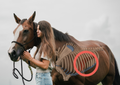
Muscle tension and compensatory movement patterns build up around an arthritic joint. The horse learns to offload the painful area, which puts strain on structures that weren't designed to carry the extra load. Over time, this creates secondary problems in the back, sacroiliac region, or opposite limb.
A qualified equine physiotherapist or osteopath can address these compensatory patterns, keep the supporting muscles and ligaments flexible, and often significantly reduce pain in ways that medication alone doesn't reach. In my experience, horses that receive regular physiotherapy alongside veterinary management maintain their quality of life noticeably longer than those that don't. It's underused, and that's a shame.
Balance pads: low-impact muscle support
For horses whose osteoarthritis has progressed to the point where ridden work is no longer appropriate, balance pads offer a gentle way to maintain muscle tone and proprioception without placing heavy loading stress on the joint. Placed under the hooves, they create a subtle instability that activates the horse's stabilising muscles, the same muscles that protect joints during movement. Electromyography studies of horses performing destabilising exercises have confirmed measurable activation of these superficial stabilising muscles within a single session [5]. Sessions are short by design, often just a few minutes per limb, but the cumulative effect on muscle engagement and coordination can be meaningful for horses at risk of losing condition from reduced activity.
Balance pads are particularly useful for older horses or those in enforced rest periods who would otherwise stand still and gradually lose the muscle support that protects their joints. We always recommend discussing with your vet before starting, especially in horses with complex lameness patterns or any neurological involvement.
Equimove Balance Pads
Vet-developed balance pads that create gentle instability under the hooves, activating stabilising muscles in short daily sessions.
Body weight and hoof care
Every kilogram of excess body weight is extra load on already-compromised cartilage. Body condition score should be assessed regularly: a score of 5 out of 9 on the Henneke scale is the target for most horses, and anything above 6 warrants a feeding review [6].
Hoof balance is equally important and often overlooked. Uneven hoof capsules change the forces passing through the limb and can dramatically alter how load is distributed across a joint. Regular farriery (every six to eight weeks for most horses) and proper trimming to maintain correct angles makes a measurable difference to comfort.
Environment matters more than you'd think
An arthritic horse needs access to a paddock where they can move freely at their own pace. That means no deep mud that makes every step an effort, no hard frozen ground in winter without some softer footing available, and ideally turnout with compatible companions who won't chase or bully them into moving faster than they want to.
Social stress is real. A horse at the bottom of a herd hierarchy who gets chased from the water trough or hay pile will be on their feet more than they should be, and under sustained low-level stress that elevates cortisol and worsens inflammation. Sometimes the simplest management change (moving one horse to a different paddock) makes a bigger difference than any supplement.
Supporting joint health in horses
Browse our range of supplements formulated for equine joint care and overall wellbeing.
View horse supplementsReferences
[1] O'Hara BP, Urban JP, Maroudas A. Influence of cyclic loading on the nutrition of articular cartilage. Annals of the Rheumatic Diseases. 1990;49(7):536-539. doi.org/10.1136/ard.49.7.536
[2] Palmer JL, Bertone AL, Malemud CJ, Mansour J. Biochemical and biomechanical alterations in equine articular cartilage following an experimentally-induced synovitis. Osteoarthritis and Cartilage. 1996;4(2):127-137. pubmed.ncbi.nlm.nih.gov/8806114
[3] Flood J, Stewart AJ. Non-Steroidal Anti-Inflammatory Drugs and Associated Toxicities in Horses. Animals. 2022;12(21):2939. doi.org/10.3390/ani12212939
[4] Yamada ALM, do Prado Vendruscolo C, Marsiglia MF, et al. Effects of oral treatment with chondroitin sulfate and glucosamine in an experimental model of metacarpophalangeal osteoarthritis in horses. BMC Veterinary Research. 2022;18(1):215. doi.org/10.1186/s12917-022-03310-y
[5] Gamucci F, Pallante M, Molle S, Merlo E, Bertuglia A. A preliminary study on the use of HD-sEMG for the functional imaging of equine superficial muscle activation during dynamic mobilization exercises. Animals. 2022;12(6):785. doi.org/10.3390/ani12060785
[6] Henneke DR, Potter GD, Kreider JL, Yeates BF. Relationship between condition score, physical measurements and body fat percentage in mares. Equine Veterinary Journal. 1983;15(4):371-372. doi.org/10.1111/j.2042-3306.1983.tb01826.x