

























Live Yeast — Saccharomyces cerevisiae Sc47
12,500 Mcfu per daily dose. Supports fibre digestion in the hindgut and maintains a stable gut microbiome. None of the 10 competing balancers included live yeast.
Shop by goal
Daily vitamin and mineral balancer
Supplements
Shop all (17)Bundles
Shop all (6)Bestsellers
Shop all (4)Foundation · every day
Targeted support
Daily supplements for the feed
Fitness and care
Reviews
Shop by goal
Supplements
Shop all (12)Bestsellers
Shop all (5)Quick view

Curafyt
DEVELOPED BY DR. SARA TORFS TO COMPLETE FORAGE-BASED DIETS
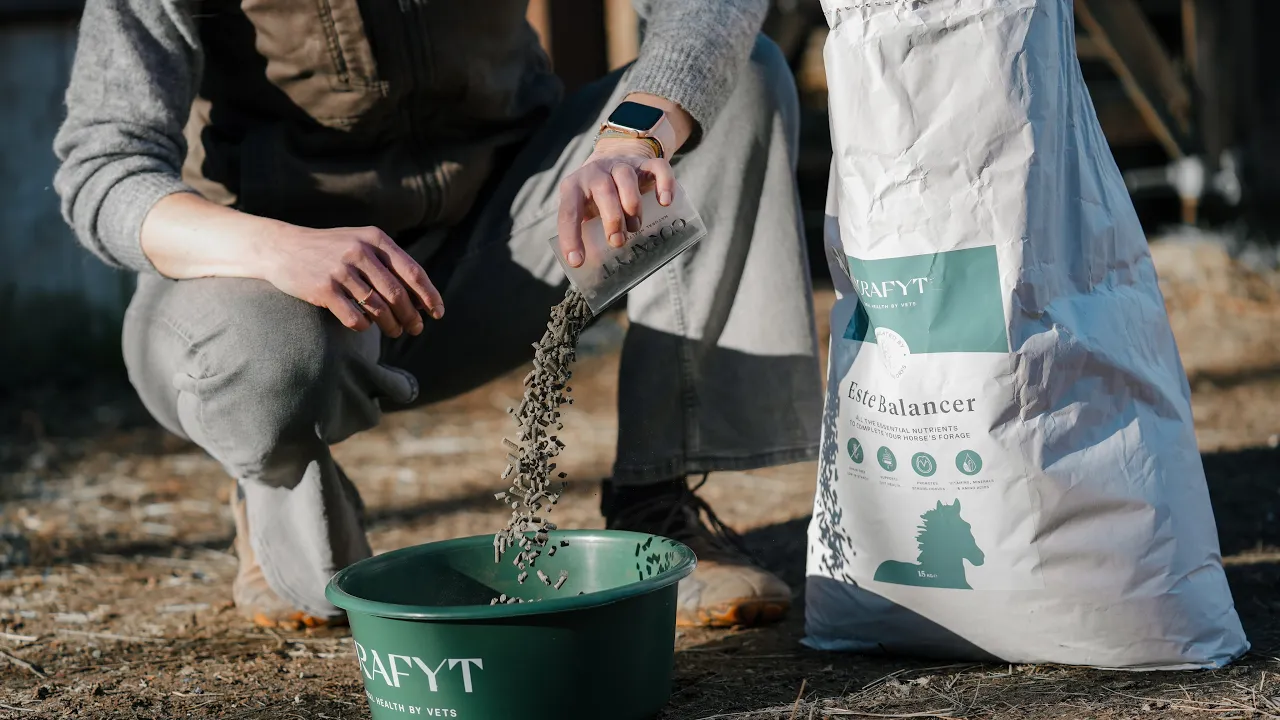
Developed by Dr. Sara Torfs, European equine internal medicine specialist, osteopath and PhD, ESTE Balancer (formerly Este Balancer Extra - Same formula) was created to help horses on forage-based diets get the nutrients they are often still missing for strong hooves, a healthy gut, a shinier coat and better overall condition.
✔ Completes the forage ration
✔ Supports digestive health
✔ Low sugar & starch formula
✔ Promotes hoof & coat quality
✔ Suitable for daily use
For horses and ponies on hay- or grass-based diets, easy keepers, horses on controlled rations, and horses needing extra daily nutritional support beyond forage alone.


DEVELOPED BY DR. SARA TORFS TO COMPLETE FORAGE-BASED DIETS
Developed by Dr. Sara Torfs, European equine internal medicine specialist, osteopath and PhD, ESTE Balancer (formerly Este Balancer Extra - Same formula) was created to help horses on forage-based diets get the nutrients they are often still missing for strong hooves, a healthy gut, a shinier coat and better overall condition.
✔ Completes the forage ration
✔ Supports digestive health
✔ Low sugar & starch formula
✔ Promotes hoof & coat quality
✔ Suitable for daily use
For horses and ponies on hay- or grass-based diets, easy keepers, horses on controlled rations, and horses needing extra daily nutritional support beyond forage alone.
Free shipping on supplement orders €80+ (under 20kg)
As a veterinarian, osteopath, and internal medicine specialist, I often met horses who weren't truly unwell, just not quite themselves or performing slightly below their potential. Blood tests regularly revealed specific nutrient deficiencies, yet no balancer on the market addressed them all. So I developed my own formula and continued to refine it over time. Today, I work with Curafyt: they help more owners discover and use this balancer, while I can stay focused on my veterinary practice.Dr. Sara TorfsEquine Internal Medicine Specialist, phd, DVMDAP Torfs

The Problem
Modern horses are fed much closer to their natural needs: more forage, less concentrate. That's great for their health. But forage alone leaves real nutritional gaps.
Wild horses roam across dozens of plant species and varied soils. Domestic horses graze a few grass species on managed land with far less nutritional diversity.
Exercise generates free radicals and increases metabolic demand, particularly for vitamin E, vitamin C, and magnesium, far beyond what forage typically provides.
Deficiencies in vitamin E, copper, zinc, and essential amino acids are among the most common findings in clinical practice.
Forage provides energy and fibre. A balancer provides precision nutrition, the exact micronutrients most missing in a modern domestic horse's diet.
Most horses don't need grain, and the research backs that up more strongly than most owners realise. Good forage at 1.5% of bodyweight covers the energy and fibre a horse in light work needs. Grain adds starch and sugar, which is exactly what drives ulcers, hindgut acidosis and laminitis risk. The gap forage leaves isn't calories. It's micronutrients. A balancer covers that gap completely, without the metabolic load of a bucket of mix. It doesn't go on top of grain, it replaces it!
WHY ESTE BALANCER WAS DEVELOPED
ESTE Balancer was born from a need Sara repeatedly saw in practice. Over the years, she carefully refined and improved the formula, and today she can confidently call it the most complete balancer on the market.

Why Dr. Sara Torfs developed Este Balancer

Why your horse needs a balancer
Este balancer is low in sugar
Science-Based Formula
Based on an independent comparison of 11 leading balancers on the European market. Key nutrients measured at recommended daily dose for a 500 kg horse.
Contains both live yeast and linseed oil, supporting gut microbiome and omega-3 intake simultaneously.
Este provides 1,500 IU Vitamin E per day vs. an average of 654 IU across comparable balancers.
Over 10× the average competitor dose, which is needed to support immune function in working horses.
Meets the upper end of clinical targets. Average across the other 10 balancers: ~4,800 mcg. Este Balancer delivers over 4× more.
Highest of all 11 balancers compared, within the recommended range. Avg. competitors: ~349 mg.
Lysine, Methionine and Threonine — only Este includes all three. Most balancers include one or none.
Formula Highlights
Most balancers cover basics. Este Balancer addresses the real-world deficiencies Dr. Torfs observed in blood work — in one coherent, science-based formula.
12,500 Mcfu per daily dose. Supports fibre digestion in the hindgut and maintains a stable gut microbiome. None of the 10 competing balancers included live yeast.
A natural source of omega-3 fatty acids (ALA) for skin and coat condition. Este is the only balancer in the comparison that includes linseed oil for optimal fat absorption.
The three most limiting amino acids for horses. Only Este includes all three — critical for muscle development, hoof and coat quality, and tissue repair.
Working horses produce free radicals that damage tissues. Este's antioxidant levels are among the highest on the market.
Most horses already receive excess iron through forage and water. Adding more can suppress copper and zinc absorption. A deliberate, evidence-based choice.
Only 3.5% starch and 4.2% sugar. Safe for EMS, PPID, and laminitis-prone horses.
Suitable For
Este Balancer was designed to be sufficient with poorer hay, yet safe alongside richer forage. It suits virtually every horse on a forage-based diet.
Low calorie, low sugar, grain-free. Provides full micronutrition without adding unwanted weight. Ideal for EMS, PPID, laminitis, and overweight horses.
Perfect for horses fed mainly hay or grass with little or no concentrate — especially where hay quality varies or is unknown.
High vitamin E, C, magnesium, and trace minerals support recovery, oxidative balance, and performance in horses in regular work.
Complete amino acid profile (lysine, methionine, threonine) supports muscle development, healthy growth, and condition in young horses and breeding mares.
what our happy customers say
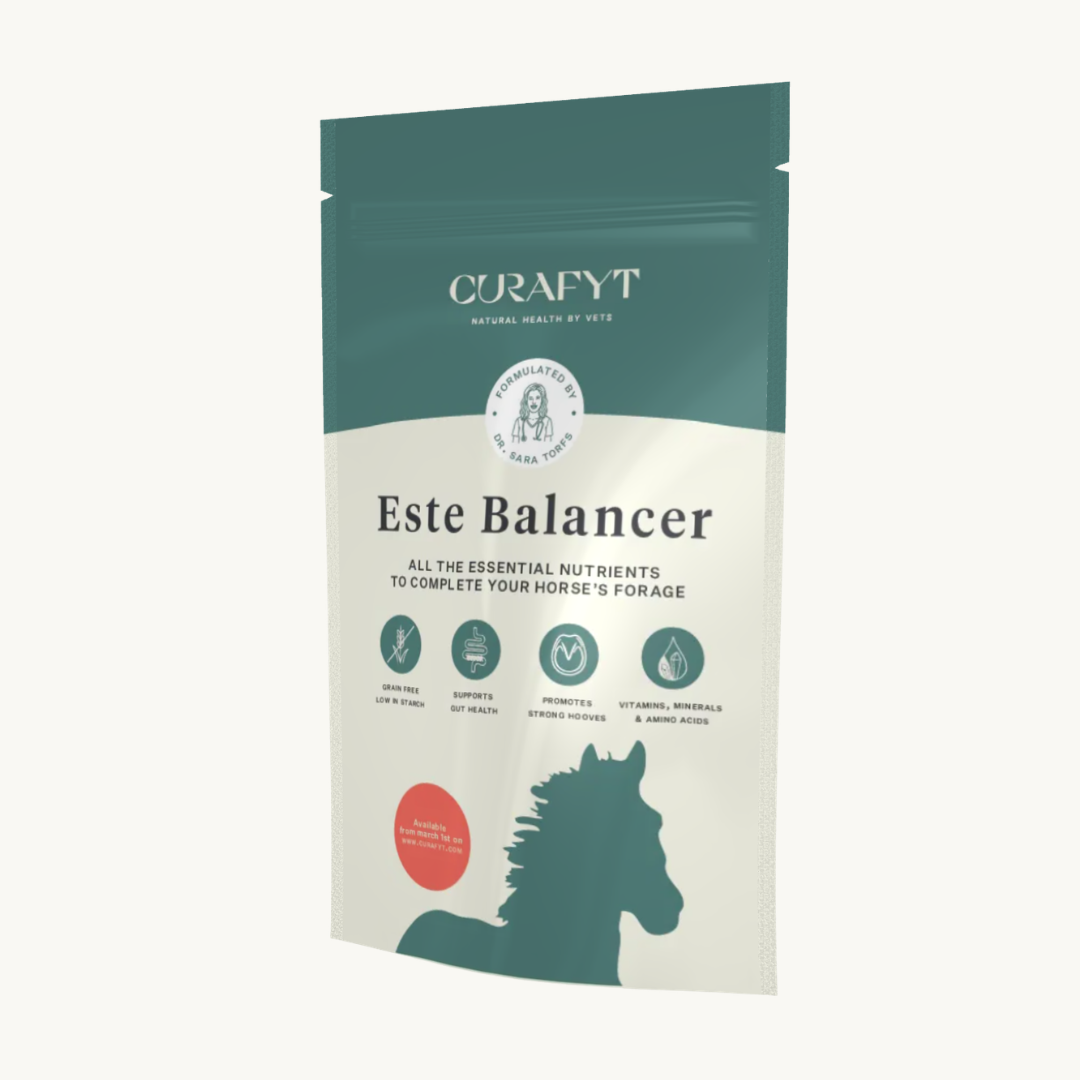
You can try with a sample first. We recommend introducing the balancer gradually over 7 days, as horses not used to low sugar food may need time to adjust. This bag contains a daily dose for a 500 kg horse. Give it in smaller portions during the transition period.
Every ingredient is chosen based on documented mechanisms of action and peer-reviewed evidence. Select a compound below to go deeper.
Medicago sativa
Source
France
Primary benefit
Part of the plant
Leaves and stems (forage)
Found in Curafyt
ESTE BALANCER by Dr. Sara Torfs →Biotin
Primary benefit
Ascorbic acid
Primary benefit
Pyridoxine
Primary benefit
Natural Vitamin E
Primary benefit
Cholecalciferol
Primary benefit
Cobalamin
Primary benefit
Calcium
Primary benefit
L-Lysine
Primary benefit
Found in Curafyt
ESTE BALANCER by Dr. Sara Torfs →DL-Methionine
Primary benefit
Found in Curafyt
ESTE BALANCER by Dr. Sara Torfs →Zinc
Primary benefit
Saccharomyces cerevisiae
Source
Belgium
Primary benefit
Part of the plant
Yeast biomass
Thiamine
Primary benefit
Riboflavin
Primary benefit
Folic acid
Primary benefit
Magnesium bisglycinate
Primary benefit
Feeding Guidelines
| Horse Weight | Daily Dose | Measuring Cup | Monthly Usage |
|---|---|---|---|
| 100 kg (small pony) | 50 g | ≈ ¼ cup | ~1.5 kg |
| 200 kg | 100 g | ≈ just under ½ cup | ~3 kg |
| 300 kg | 150 g | ≈ ⅔ cup | ~4.5 kg |
| 400 kg | 200 g | ≈ ¾ cup | ~6 kg |
| 500 kg (standard horse) | 250 g | ≈ 1 full cup (330 ml line) | ~7.5 kg |
| 600 kg | 300 g | ≈ 1¼ cups | ~9 kg |
| 700 kg | 350 g | ≈ 1½ cups | ~10.5 kg |
The measuring cup is designed specifically for Este Balancer (≈ 250 g). When combining with concentrates: reduce balancer dose by 50 g per 1 kg of concentrate fed daily.
Switching to a low-sugar balancer is easier if you do it gradually.
Why it tastes different
Este Balancer is intentionally low in sugar. Horses used to sweet feed need time to adjust. This is completely normal.
Product FAQs
Get Started
Join 35,000+ horses already benefiting from Este Balancer. Take a monthly subscription and save 10%. Free shipping, no contract, cancel anytime.