Why is my horse too skinny?
 by Valerie De Clerck on Sep 21 2023· 6 min read
Key takeaways
- Use the Body Condition Score, a 1 to 9 scale developed by Henneke in 1983, to assess your horse objectively. A score of 5 is ideal, and if you can see the ribs rather than just feel them, your horse is underweight.
- Nearly one in twenty horses over 15 scores as underweight on a standard body condition scale, and dental problems, especially cheek teeth diastemata, are common enough to check for at least twice a year.
- Energy needs shift a lot with circumstance: light training adds about 20%, hard work over 60%, late pregnancy roughly a quarter to a third more, lactation nearly double, and serious illness or surgery recovery another 10 to 60%.
- Rule out illness, dental disease, and parasites before adjusting the diet, since poor quality feed, malabsorption from gut inflammation, and heavy worm burdens can all cause weight loss that looks the same from the outside.
Almost one in twenty horses over 15 scores low enough on a standard body condition scale to count as underweight, according to a 2012 UK veterinary survey of 200 geriatric horses [1]. That's not just a cosmetic issue. Sustained weight loss can turn life-threatening fast, and the tricky part is that the cause is rarely obvious. Teeth, worms, a diet that looks fine on paper, a body simply burning more than it takes in: any of these can be behind it. Here's how to work through the possibilities, step by step.
STEP ONE — check whether your horse is too skinny
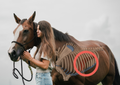
Start with the Body Condition Score (BCS), developed by Don Henneke and colleagues at Texas A&M in 1983 [2]. It's still the standard way to assess fat cover without a scale or calipers: just your eyes and hands on six key points, the neck, withers, loin, tailhead, ribs, and behind the shoulder.
The scale runs from 1 (emaciated) to 9 (extremely fat). A score of 5 is the sweet spot. If you can see your horse's ribs rather than just feel them under light pressure, he's underweight.
Ideally, you should be able to feel your horse's ribs, not see them.
STEP TWO — figure out why your horse is too skinny
The most common causes of weight loss in horses and ponies are anorexia, a higher energy requirement, malnutrition, malabsorption, and parasites.
1. Your horse refuses to eat (anorexia)
Refusing feed can signal illness, pain, or anxiety, and it's not something to wait out. If your horse hasn't eaten in 48 hours, call your vet.
Anorexia has a long list of possible causes, so a proper exam beats guessing every time. Horses have a digestive system that punishes delay, so don't leave it too long.
Tip: get your vet to check your horse's teeth at least twice a year. It rules out one of the most common, and most often missed, reasons horses go off their feed.
Cheek teeth diastemata, small gaps that open up between the molars as a horse ages and trap rotting feed, are more common than most owners assume. A UK study of 471 horses in general practice found them in nearly half the population (49.9%) [3], and in horses referred specifically for the condition, quidding, dropping little balls of half-chewed hay, was present in over three-quarters of cases [4].
If your horse is struggling with his teeth, he may:
- eat slowly
- have trouble chewing
- spill or drop grain
- spit out quids of hay
- drool more than usual
- shift feed around his mouth without swallowing it
- develop bad breath
- pack roughage into his cheeks, giving him a slightly chipmunk look
2. Your horse requires more energy
If your horse burns more energy than he takes in, he loses weight. Plenty of situations raise that energy need, and by how much varies a lot from horse to horse.
2.1. Sport horses
More training means more energy, which is obvious enough. What's less obvious is the size of the gap: standard feeding guidelines put light work at roughly 20% above maintenance energy needs, climbing past 60% for horses in hard, regular work [7]. That's not a small top-up.
2.2. Pregnant and lactating mares
In the final three months of pregnancy, a mare's energy needs climb by roughly a quarter to a third, more if she's carrying a big foal [7]. Once she's nursing, that requirement can very nearly double. Milk production is expensive, and a mare who isn't fed accordingly will strip her own condition to keep the foal growing.
2.3. Older horses
Ageing guts absorb nutrients less efficiently, so older horses often need more energy just to hold steady weight, even on a ration that used to be plenty.
2.4. Horses recovering from illness or surgery
Recovery costs energy too. A horse healing from surgery needs roughly 10% more than usual, and a serious illness can push that figure past 60% [7]. Unhelpfully, this is exactly when appetite tends to drop.
2.5. Cold and heat take a toll too
A well-acclimatised adult horse's lower critical temperature, the point where the body starts burning extra energy just to stay warm, sits around -15°C [5]. Below that threshold, plan on roughly 2.5% more energy for every degree the temperature drops [5]. Hot, humid weather adds a cost of its own through sweating and cooling, though it's harder to put a clean number on than the cold-weather math.
3. Your horse is malnourished
Sometimes the amount is fine but the quality isn't. Poor hay, mouldy grain, or a ration that hasn't been reassessed in years can leave a horse under-fed even when the bucket looks full at every meal.
4. Your horse doesn't absorb nutrients (malabsorption)
This is different from malnutrition. Here, the horse eats enough good quality feed, but his gut doesn't do its job properly, so nutrients pass through instead of being absorbed. Inflammation of the intestine is usually the culprit.
5. Your horse has parasites
Heavy worm burdens, cyathostomins (small strongyles) especially, damage the gut lining and compete directly for the nutrients your horse needs. In severe cases, particularly when large numbers of larvae emerge from the gut wall at once, the result can be sudden weight loss and diarrhoea [6]. Weight can drop fast once that happens, sometimes within a couple of weeks.
STEP THREE — treat your horse
You are what you eat. That goes for horses too. If your horse is underweight and there's no underlying illness or worm burden behind it, diet is usually where to start, and where you'll see the fastest results.
Good to know
Weight gain in horses should be gradual. A sudden jump in calories on a gut that has adapted to less can trigger colic or laminitis, so build up slowly and let the changes show over weeks, not days.
Grow & Glow
A vet-formulated omega-3 oil for horses that need extra condition: underweight horses, hard-working horses, and mares in late pregnancy or lactation. No added sugars, and Clean Sport compliant for competition horses.
Not sure where to start?
Browse our full range of condition and weight support built for horses that need to put on healthy weight.
Shop weight managementReferences
[1] Ireland JL, Clegg PD, McGowan CM, McKane SA, Chandler KJ, Pinchbeck GL. Disease prevalence in geriatric horses in the United Kingdom: veterinary clinical assessment of 200 cases. Equine Vet J. 2012;44(1):101-106.
[2] Henneke DR, Potter GD, Kreider JL, Yeates BF. Relationship between condition score, physical measurements and body fat percentage in mares. Equine Vet J. 1983;15(4):371-372.
[3] Walker H, Chinn E, Holmes S, Barwise-Munro L, Robertson V, Mould R, Bradley S, Shaw DJ, Dixon PM. Prevalence and some clinical characteristics of equine cheek teeth diastemata in 471 horses examined in a UK first-opinion equine practice (2008 to 2009). Vet Rec. 2012;171(2):44.
[4] Dixon PM, Ceen S, Barnett T, O'Leary JM, Parkin TD, Barakzai S. A long-term study on the clinical effects of mechanical widening of cheek teeth diastemata for treatment of periodontitis in 202 horses (2008-2011). Equine Vet J. 2014;46(1):76-80.
[5] Cymbaluk NF. Thermoregulation of horses in cold, winter weather: a review. Livest Prod Sci. 1994;40(1):65-71.
[6] Corning S. Equine cyathostomins: a review of biology, clinical significance and therapy. Parasites & Vectors. 2009;2(Suppl 2):S1.
[7] National Research Council. Nutrient Requirements of Horses. 6th rev. ed. Washington, DC: National Academies Press; 2007.
Share