
























Spotting osteoarthritis in older dogs
 by Valerie De Clerck on Sep 21 2023· 4 min read
Key takeaways
- Osteoarthritis is a painful, one-way joint inflammation caused by cartilage breakdown, so managing it early matters more than treating it later.
- Watch for subtle behavior changes like morning stiffness, reluctance to jump in the car, or a shorter temper, since dogs with arthritis rarely yelp or whine.
- Older, large-breed dogs face the highest risk, but prior joint problems and excess body weight raise the odds for dogs of any age or size.
- Keeping weight down, favoring steady low-impact walks over occasional long hikes, and adding omega-3s or a joint supplement can ease discomfort alongside regular vet care.
Dogs age the way we do, joint by joint. Osteoarthritis is one of the most common things that creeps in, a painful inflammation driven by the slow breakdown of joint cartilage. The hard part is that it rarely announces itself. Catch it early and you can change the course of it with the right exercise, the right food, and a good joint supplement. Miss it, and your dog quietly learns to live with pain.
What osteoarthritis actually is
Osteoarthritis, often just called arthritis, is a painful inflammation of the joints, usually caused by wear and tear over time. Any joint can be affected. The knees, elbows, hips, toes, and the small joints along the spine take the worst of it.
Here is the mechanism, briefly. A joint sits between two bone ends, and each end is capped with cartilage. Cartilage is soft tissue with no blood vessels and no nerves, and it works as a shock absorber. The fluid inside the joint, the synovial fluid, lubricates that cartilage during movement and feeds it.
In osteoarthritis the cartilage gets damaged, so it absorbs less shock. The synovial fluid changes too, so it lubricates less well. Then the inflammation that follows chews away at what cartilage is left [1]. It is a loop, and it does not reverse on its own. That is the uncomfortable truth: you are managing it, not curing it.
Which dogs are most at risk?
Older, large-breed dogs are the classic candidates. But age and size are not the whole story. Any dog, any age, can develop it. Dogs carrying earlier joint problems are especially exposed. Things like hip or elbow dysplasia, or a knee that went through cruciate surgery years ago, all raise the risk [2]. Excess body weight piles on extra load and speeds up the whole process [3]. It is also one of the only risk factors an owner has real control over.
Old age is not an illness
The early signs of osteoarthritis get waved away as "he's just getting old." If your dog is becoming less flexible, book the vet. Slowing down a bit is normal. Stiffness, reluctance, and pain are not.
How to spot it: 8 early signs
Osteoarthritis shows up in behaviour long before it shows up on an x-ray. Watch for these.
- Stiffness, particularly first thing in the morning
- Less interest in walks, or wanting to turn back early
- Trouble getting up off the floor or settling down
- Hesitating or struggling to jump in and out of the car
- Sitting or lying down partway through a walk
- A shorter fuse than usual, even outright grumpiness
- Flinching or pulling away when touched in a certain spot
- Limping after a long rest that loosens up once he gets moving
One detail matters more than the rest. Dogs with osteoarthritis rarely yelp or whine, and that throws a lot of owners off. The pain is chronic, a steady background ache, not the sharp jolt that makes a dog cry out after a bad step. So do not wait for a noise that may never come. The quiet dog can be the one in the most pain.
"Pain that doesn't make a sound is the easiest pain to ignore, and the most important not to."Curafyt veterinary team
What you can do about it
There is no single fix. The dogs that do best get managed on a few fronts at once. Keep weight down, since every extra kilo lands on already-sore joints [3]. Keep movement steady and low-impact rather than weekend-warrior bursts: two or three calm walks beat one long hike that leaves him stiff for days.
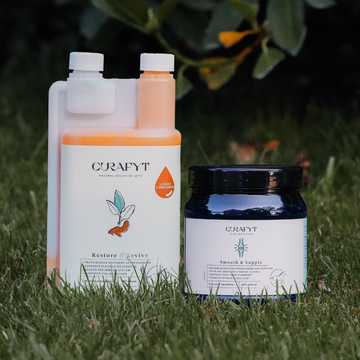
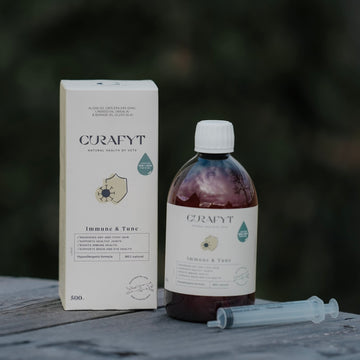
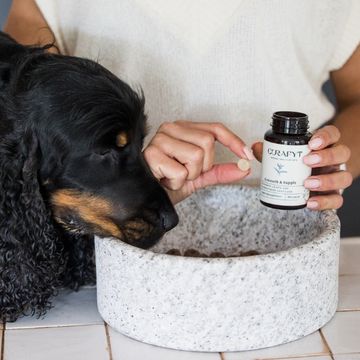
On the nutrition side, omega-3 fatty acids from fish oil have decent evidence behind them for easing arthritis-related discomfort and improving how dogs move [4]. A joint supplement such as Curafyt's Smooth & Supple combines those omega-3s with cartilage-support ingredients, which is the kind of daily backup these joints need. It is not a cure, and any supplement works better alongside vet care than instead of it. Talk to your vet about pain relief too, especially in the colder months when stiffness tends to bite harder.
Support your dog's joints early
Smooth & Supple combines omega-3s and cartilage support for everyday mobility.
Shop dog supplementsScientific references
[1] Anderson KL, et al. Prevalence, duration and risk factors for appendicular osteoarthritis in a UK dog population under primary veterinary care. Scientific Reports, 2018.
[2] Johnston SA. Osteoarthritis: joint anatomy, physiology, and pathobiology. Veterinary Clinics of North America: Small Animal Practice, 1997.
[3] Kealy RD, et al. Effects of diet restriction on life span and age-related changes in dogs. Journal of the American Veterinary Medical Association, 2002.
[4] Roush JK, et al. Multicenter veterinary practice assessment of the effects of omega-3 fatty acids on osteoarthritis in dogs. Journal of the American Veterinary Medical Association, 2010.
Share