This is how you treat an underweight horse
 by Valerie De Clerck on Sep 21 2023· 8 min read
Key takeaways
- Confirm your horse is actually underweight with a Body Condition Score of 1 to 9, checking both fat cover and muscle mass by hand rather than relying on the eye alone.
- Look for the underlying cause before changing feed. In a 60-case study, parasites and dental disease together explained half of all chronic weight loss cases, well ahead of poor feed quality.
- Rule out illness, dental problems, and parasites with your vet first, then audit whether roughage meets 1.5 to 2% of bodyweight in dry matter before adding anything else.
- For horses needing more calories, favor a high omega-3 vegetable oil over grain — about 2.25x the digestible energy of carbohydrates without starch-related colic/laminitis risk. Condition typically takes 60-90 days to show.
Feed is the last lever you pull, not the first. Most owners do it the other way around. A horse drops condition and within a week the bucket is fuller, the supplement shelf is busier, and nobody has stopped to ask why the weight is going in the first place.
Weight & muscle series
Read the other articles: Treating an underweight horse · Is your horse too skinny? · Muscle growth
Sometimes more feed is exactly what's needed. The horse just wasn't eating enough, and the fix is straightforward. But in practice, those aren't the cases I tend to see. Dental disease that makes chewing painful, a gut that cannot absorb what it's given, a parasite burden quietly competing for every nutrient: these are the reasons a horse stays thin while its owner goes through feed change after feed change. Getting to the cause first is what changes the outcome.
By the numbers
A retrospective review of 60 horses referred to a veterinary clinic for chronic weight loss found parasitic disease behind 30% of cases and dental disease behind another 20%.[1] Feed quality wasn't even in the top two.
Step 1: Confirm the horse is actually underweight
The eye is not reliable on its own. A horse with a thick winter coat can hide significant muscle loss, and conversely, a fine-coated horse can look lean and still carry adequate condition. Use the Body Condition Score (BCS), which runs from 1 (emaciated) to 9 (obese).[2] A score of 4 to 6 is generally healthy; anything at 3 or below warrants action.
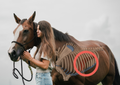
Scoring requires both looking and feeling. Run your hands along the ribs, the spine, the croup, the base of the neck, and behind the shoulder. You are assessing fat cover and muscle mass at the same time: they are different things and can deteriorate independently. A horse with a BCS of 4 but with significant topline muscle loss is in a different situation than one with the same score but good muscle bulk. That distinction matters more than most owners realise.
Step 2: Find the reason
Weight loss rarely has a single cause. The five below commonly overlap, and treating one while missing another is exactly why some horses take months to turn around.
Reduced appetite (anorexia)
The horse is not eating enough because something is making them reluctant to eat. Pain, stress, a change in environment, dominant herdmates, or illness can all reduce intake without you seeing an obvious sign of it. Observe feed time closely.
Higher energy demand than supply
Hard work, cold weather, late pregnancy, and lactation all raise the energy requirement substantially. A ration that maintained a horse last summer may simply not be enough now. The need increased; the feed did not.
Poor diet quality
Hay that looks fine can be nutritionally thin. Protein, digestible energy, and mineral content vary widely between cuts, between fields, between years. You cannot assess nutritional value by appearance alone.
Malabsorption
In some horses, particularly older horses and those with inflammatory bowel disease, the gut simply does not absorb nutrients efficiently. A 2024 study of 149 horses with IBD-type changes on biopsy found that most of them had some degree of impaired glucose absorption on testing, despite eating normally.[3] These animals eat enough but still lose weight, and they often respond poorly to a straightforward feed increase.
Parasites
A high parasite burden in younger horses is a classic cause of poor condition that owners underestimate. A targeted fecal egg count, rather than a calendar-based deworming schedule, gives you actual information about what is happening in your individual horse. It's also the current veterinary standard: national parasite control guidelines have moved away from fixed-interval deworming precisely because rotating dewormers on autopilot accelerates drug resistance without reliably controlling the horses carrying a heavy burden.[4]
Step 3: Treat, in the right order
The instinct is to reach for more feed immediately. Resist it. Feed is the last lever you pull, not the first, or you risk addressing a symptom while the underlying problem continues.
Call your vet first
Before adjusting the ration, rule out illness, internal parasites, and dental disease. This last one is underdiagnosed. Sharp enamel points, loose teeth, and periodontal disease make chewing painful and reduce the efficiency of forage breakdown significantly. In clinical practice, correcting dental problems in an older horse with chronic weight loss often produces faster improvement than any feed change.
Good to know
Horses aged 15 and older should have dental exams at least once a year. Molar problems in particular develop slowly and are easy to miss until weight loss is already advanced.
Audit the roughage
Roughage, hay and grass, is the foundation. A horse in light work needs roughly 1.5 to 2% of its bodyweight in dry matter per day, predominantly as forage. Before adding supplements or concentrates, check that the basic roughage requirement is being met in terms of both quantity and quality.
If you have reason to doubt the quality of your hay, then analyse it! Some universities with veterinary nutrition programs offer hay analysis, and several feed companies will analyse forage samples. The cost is modest relative to months of feeding hay that isn't delivering what you assume it is.
Adjust the diet for the specific problem
For horses with dental problems: move toward short-cut grass fibres that require less chewing effort, and consider a wet mash as a component of the ration. These horses can consume adequate calories without the mechanical demand of long-stem hay.
For horses whose energy needs have gone up, whether from work, cold, or recovery, the instinct is often to add grain. Be careful here. Grain is high in starch and sugar; in a horse with a compromised gut from parasites or malabsorption, or in any horse with a susceptibility to metabolic issues, large grain meals increase the risk of colic and laminitis. The safer route to sustained energy is fat.
Vegetable oil as a calorie source
Fat delivers roughly 2.25 times the digestible energy of carbohydrates per gram.[5] More importantly, it delivers that energy without the glycemic spike associated with starch. This has several practical benefits that go beyond simple weight gain.
In clinical practice, horses switched from grain-heavy rations to oil-supplemented rations often show a noticeable change in temperament: more workable, less reactive. That lines up with what's been measured experimentally: horses fed a fat-supplemented diet showed a milder startle response and lower stress indicators than horses on a starch-rich diet.[6] The glucose-sparing effect of fat metabolism plays a part here too: the muscles preferentially burn fat during sustained work, leaving blood glucose available for the brain. Horses that were edgy on high-grain diets frequently settle.
There are measurable physical benefits too. Horses on appropriate fat supplementation typically show improved coat condition and, for those in work, better thermoregulation: less heat generated during exercise means less sweating and faster recovery. Aerobic efficiency improves as the body adapts to fat as a primary fuel, which is visible in a working horse's recovery time after effort.
Not all vegetable oils are equivalent. The ratio of omega-3 to omega-6 fatty acids matters. Most conventional vegetable oils (sunflower, corn) are very high in omega-6 and low in omega-3. Omega-6 fats are precursors to pro-inflammatory prostaglandins, so a diet skewed heavily toward them can, over time, promote rather than dampen inflammation.[7] Choose an oil with a high omega-3 content, specifically DHA, for the best outcome.
Grow & Glow Oil Liquid Supplement
A plant-based oil supplement high in DHA omega-3 fatty acids: supports healthy weight gain, coat condition, and gut health in horses.
A note on patience
Horses do not regain condition quickly. Even when the underlying cause has been corrected and the diet is right, rebuilding body condition typically takes 60 to 90 days to show clearly on the BCS scale. Owners who do not see rapid improvement sometimes assume the approach is wrong and start making more changes, which makes it impossible to know what is working.
Pick the right approach, be consistent, and give it time. Check the BCS every 2 to 3 weeks and track it. Progress is usually there. It's just slower than we want it to be.
Support weight gain the right way
Browse our vet-formulated weight gain supplements for sustained, healthy results.
See weight gain supplementsReferences
[1] Tamzali Y. Chronic weight loss syndrome in the horse: a 60 case retrospective study. Equine Veterinary Education. 2006;18(6):289-296.
[2] Henneke DR, Potter GD, Kreider JL, Yeates BF. Relationship between condition score, physical measurements and body fat percentage in mares. Equine Veterinary Journal. 1983;15(4):371-372. pubmed.ncbi.nlm.nih.gov/6641685
[3] Kranenburg LC, Bouwmeester BF, van den Boom R. Findings and prognosis in 149 horses with histological changes compatible with inflammatory bowel disease. Animals. 2024;14(11):1638. pmc.ncbi.nlm.nih.gov/articles/PMC11171156
[4] AAEP Parasite Control Subcommittee (Nielsen MK, chair). AAEP Internal Parasite Control Guidelines. American Association of Equine Practitioners, revised 2019. aaep.org/resource/internal-parasite-control-guidelines
[5] National Research Council. Nutrient Requirements of Horses, 6th Revised Edition. Washington, DC: The National Academies Press; 2007. nap.nationalacademies.org/catalog/11653
[6] Redondo AJ, Carranza J, Trigo P. Fat diet reduces stress and intensity of startle reaction in horses. Applied Animal Behaviour Science. 2009;118(1-2):69-75. sciencedirect.com/science/article/abs/pii/S0168159109000355
[7] Simopoulos AP. The importance of the ratio of omega-6/omega-3 essential fatty acids. Biomedicine & Pharmacotherapy. 2002;56(8):365-379. pubmed.ncbi.nlm.nih.gov/12442909
Share