























Broholmer: characteristics, training and care
 by Nicolas Bartholomeeusen on Jun 14 2026· 6 min read
Key takeaways
- The Broholmer nearly went extinct after World War II and was only recognized by the FCI in 1982, so it remains a rare breed today.
- Adult males reach up to 75 cm and 70 kg, which makes hip and elbow dysplasia a lifelong watch point backed by genetic screening data [1].
- Deep-chested giant breeds like the Broholmer face a bloat (GDV) incidence of 23 to 26 cases per 1,000 dog-years, well above smaller dogs [2].
- Life expectancy runs 7 to 12 years, shorter than most breeds, so preventive vet care and a balanced diet matter even more.
The Broholmer, also known as the Danish Mastiff, is a large and imposing breed of dog from Denmark. This breed has a rich history dating back to the Middle Ages and was originally bred for hunting and guarding. Nowadays, the Broholmer is mainly valued as a family and companion dog due to its calm and friendly nature. This article covers everything you need to know about this rare breed, including its physical characteristics, training, nutrition and health.
History of the Broholmer
The history of the Broholmer begins in the Middle Ages, when the breed served as a guard dog and hunting dog for large game such as deer and wild boar. Over the centuries, the Broholmer has undergone various transformations.Origins of the Broholmer
The origins of the Broholmer date back to the Viking Age, when mastiff-like dogs were imported from England and other regions and crossed with local Danish dogs. This resulted in a sturdy and robust guard dog.The role of the Danish nobility
During the 18th and 19th centuries, the Broholmer became particularly popular amongst the nobility. Count Sehested of the Broholm estate played a key role in the preservation and standardisation of the breed, giving it its name.Near extinction and recovery
After the Second World War, the number of Broholmers declined drastically, causing the breed to almost disappear. In the 1970s, a revival programme was launched, leading to official recognition by the Fédération Cynologique Internationale (FCI) in 1982.Character and temperament of a Broholmer
The Broholmer is known for its calm, balanced and confident nature. It is loyal, friendly and an excellent family dog.Behaviour within the family
The Broholmer is extremely affectionate and protective towards its family. It is tolerant of children and behaves patiently in family settings.Watchfulness and social behaviour
The Broholmer is not naturally aggressive, but due to its strong guarding instinct, it will be wary of strangers and unwanted visitors. With proper socialisation, Broholmers get on well with other pets and dogs.Physical characteristics of the Broholmer
The Broholmer is a large and muscular breed with an impressive appearance.Size and weight
- Males: 75 cm at the withers, 50–70 kg in weight.
- Bitches: 70 cm at the withers, 40–60 kg.
Appearance
The Broholmer has a broad skull, a powerful muzzle and a muscular body. Its long, straight back and sturdy legs contribute to its stately appearance.Coat and colours
The Broholmer has a short, thick coat that lies close to the body. Coat colours are usually yellow, brown-yellow or black with white markings.Care and hygiene
Care for the Broholmer is relatively simple due to its short coat.Coat care
- Brush at least once a week to remove loose hair and dirt.
- Bathing is only necessary a few times a year using a mild dog shampoo.
General hygiene measures
- Check and clean the ears regularly.
- Trim nails to prevent discomfort.
- Brush teeth to prevent tartar and gum problems.
Socialisation and behaviour with other dogs
Early socialisation is essential to ensure that the Broholmer gets on well with other dogs.- Generally friendly and sociable, but may be reserved towards unfamiliar dogs.
- Early exposure to other dogs, people and situations promotes good behaviour.
Training and upbringing
Consistent, patient and structured training is required for a Broholmer.Key training techniques
- Positive reinforcement with rewards and praise.
- Early socialisation prevents anxiety or aggression later in life.
- Clear rules and boundaries are crucial to avoid dominant behaviour.
Suitable living conditions
The Broholmer needs plenty of space and exercise to stay happy and healthy.- Although they can live in a flat, a house with a large garden or access to spacious walking areas is ideal.
- At least 45 minutes of exercise daily, such as long walks or play sessions.
Health and hereditary conditions
The Broholmer is a fairly robust dog, but its size works against it in a few predictable ways. Owners should know what to watch for.Common conditions
- Hip dysplasia and elbow dysplasia — joint conditions common in large and giant breeds, where genetic selection over the past decades has measurably reduced but not eliminated the risk [1].
- Gastric torsion (bloat) — large, deep-chested breeds carry a meaningfully higher lifetime risk of this life-threatening emergency than smaller dogs [2].
- Heart problems — dilated cardiomyopathy shows up more often in giant breeds, including Great Danes and other mastiff-type dogs, than in the general dog population [3].
- Eye problems such as entropion — more common in molosser-type breeds with loose facial skin, and it can lead to painful corneal irritation if left untreated [4].
- Obesity due to lack of exercise — dogs that get less weekly exercise consistently carry higher body condition scores, and a large frame makes the extra weight harder on joints already under strain [5].
Good to know
Large and giant breeds face a GDV (bloat) incidence of roughly 23 to 26 cases per 1,000 dog-years, well above smaller breeds [2]. Feeding smaller meals, slowing down fast eaters and avoiding strenuous exercise right after eating are among the few risk factors an owner can actually manage.
IMBY Hip & Joint Supplement
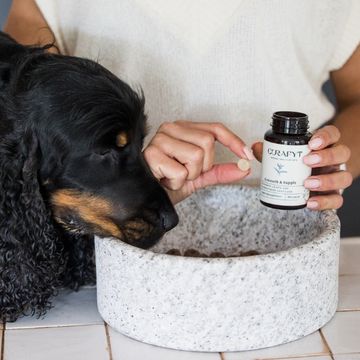
Vet-formulated daily joint support to help maintain flexible movement and healthy cartilage as a large-framed dog like the Broholmer ages.
Promoting good health
A balanced diet, regular exercise and preventive veterinary check-ups reduce the risk of health problems.Life expectancy
The life expectancy of a Broholmer is between 7 and 12 years.Costs and care
The Broholmer is a rare breed, which makes the price relatively high.- Purchase price: €1,350 – €1,600.
- Monthly costs: €70 - €150 for nutrition, veterinary care and other essentials.
Nutrition and diet
Nutrition plays an essential role in the health of a Broholmer.Nutritional requirements
- High-quality proteins (meat, fish)
- Healthy fats (omega-3 and -6)
- Limited carbohydrates (low-glycaemic fruit and vegetables)
Name ideas for a Broholmer
Here are a few names that suit this majestic breed:- For males: Thor, Odin, Max, Diesel.
- For females: Freya, Luna, Bella, Nala.
Conclusion
The Broholmer is a devoted, reliable and friendly dog that fits well into family environments. With the right training, plenty of exercise and a balanced diet, this Danish giant can be a fantastic companion.Support your Broholmer's joints for life
A large frame puts more strain on hips and elbows for more years. A daily joint supplement helps keep a Broholmer moving comfortably well into its senior years.
Shop joint & mobility supportReferences
[1] Oberbauer AM, Keller GG, Famula TR. Long-term genetic selection reduced prevalence of hip and elbow dysplasia in 60 dog breeds. PLoS One. 2017;12(2):e0172918.
[2] Glickman LT, Glickman NW, Schellenberg DB, Raghavan M, Lee TL. Incidence of and breed-related risk factors for gastric dilatation-volvulus in dogs. J Am Vet Med Assoc. 2000;216(1):40-45.
[3] Freid KJ, Freeman LM, Rush JE, Cunningham SM, Davis MS, Karlin ET, Yang VK. Retrospective study of dilated cardiomyopathy in dogs. J Vet Intern Med. 2021;35(1):58-67.
[4] O'Neill DG, Mustikka MP, Brodbelt DC, Church DB, Vaattovaara V. Conformational eyelid disorders in dogs under primary veterinary care in the UK. PLOS ONE. 2025;20:e0326526.
[5] German AJ, Blackwell E, Evans M, Westgarth C. Overweight dogs exercise less frequently and for shorter periods: results of a large online survey of dog owners from the UK. J Nutr Sci. 2017;6:e11.
Share