






















Ectropion dog: causes, symptoms and treatment options
 by Nicolas Bartholomeeusen on Jun 14 2026· 6 min read
Key takeaways
- Ectropion happens when the lower eyelid rolls outward, most often in breeds with loose facial skin like Bloodhounds, Saint Bernards and Basset Hounds.
- Watch for a visible pink conjunctiva, excessive tearing, redness or discharge, and get a vet to confirm it rather than guessing.
- Most diagnosed cases are managed with drops and ointments rather than surgery, though severe cases need surgical correction with a 10 to 14 day recovery.
- Since ectropion is often hereditary, responsible breeding and regular eye checks in high-risk breeds help catch it early.
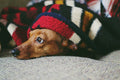
Ectropion in dogs is an eye condition where the lower eyelid rolls outward, away from the eyeball, leaving it prone to chronic irritation and inflammation. It's particularly common in breeds with loose facial skin, such as the Bloodhound, Saint Bernard and Basset Hound. Some cases are hereditary; others develop later from trauma, scarring or simple ageing. Symptoms range from watery or dry eyes to redness and excess tear production, which can tip over into secondary infection if it's left alone. Treatment spans everything from eye ointments and artificial tears to surgery for the more severe cases. Here's what actually causes it, how to spot it, and what treatment looks like.
What are the causes of ectropion in dogs?
Ectropion can stem from genetics, physiology, or something external. The most common causes:
- Genetic predisposition: breeds such as the Bloodhound, Saint Bernard, Basset Hound, Mastiff and Cocker Spaniel carry loose skin and longer eyelids by conformation, which raises ectropion risk considerably [1].
- Congenital abnormalities: some puppies are simply born with eyelids too long or floppy to sit snugly against the eyeball.
- Ageing: as a dog gets older, eyelid tissue can lose tone and start to sag.
- Injury or scarring: trauma to the eyelid, or scarring from a previous surgery such as entropion correction, can pull the lid outward [3].
- Neurological disorders: facial nerve paralysis can leave an eyelid drooping regardless of its underlying conformation.
Which dog breeds are most at risk of ectropion?
The largest recent study on this, a 2025 analysis of over 2.2 million UK dogs under primary veterinary care, found the highest ectropion risk in Neapolitan Mastiffs, Saint Bernards, Great Danes and Basset Hounds, with Bloodhounds and Cocker Spaniels also well represented [1]. Interestingly, that same study found ectropion is diagnosed far less often than its counterpart entropion (inward-rolling eyelid) in general practice, and most cases, over 95%, are managed medically rather than surgically [1]. Giant and mastiff-type breeds in particular can develop a combined eyelid problem, sometimes called "diamond eye," where entropion and ectropion occur on different parts of the same lid at once [2].
What are the symptoms of ectropion in dogs?
Dogs with ectropion typically show:
- Drooping eyelids: the lower lid hangs loose, exposing the pink conjunctiva underneath.
- Excessive tearing or dry eyes: an open, poorly-fitted eyelid disrupts the tear film, so tears either evaporate too fast or overflow instead of draining normally.
- Redness and inflammation: constant exposure to dust and bacteria irritates the exposed tissue.
- Mucous or pus-like discharge: a natural consequence of reduced eye protection.
- Light sensitivity: some dogs squint or avoid bright light when the eye is irritated.
Left unaddressed, this chronic exposure raises the risk of conjunctivitis and keratitis, since the eye simply isn't getting the protection and even tear distribution it needs [3].
How can you recognise ectropion in your dog?
Watch for a visibly exposed pink conjunctiva, tearing that seems excessive, redness or irritation around the eye, any discharge, and occasional squinting. Any of these is worth a vet visit for a proper look.
Good to know
Ectropion isn't always present from birth. Scarring from an injury, an infection, or even a previous eyelid surgery can pull the lid outward later in life, a pattern documented in dogs recovering from burns and chronic skin disease alike [4][5]. If your dog develops droopy, irritated eyelids well into adulthood with no breed predisposition, scarring is worth ruling out.
How is ectropion diagnosed in dogs?
Diagnosis usually starts with a straightforward visual exam. If needed, a veterinary ophthalmologist may run further tests:
- Fluorescein staining: checks for corneal damage from dryness or debris.
- Schirmer test: measures tear production to confirm the eye is staying adequately hydrated.
- Slit-lamp examination: a closer look at the eyelids and cornea for additional damage.
When should you take your dog to the veterinarian for ectropion?
Go promptly if your dog is squinting or looking off in one or both eyes, has excessive tearing or pus-like discharge, seems pained in bright light, or has recurring eye irritation or infections.
What are the possible treatments for ectropion in dogs?
Treatment depends on severity.
Can ectropion heal on its own?
In mild cases, particularly in young dogs, it can improve as the dog grows. Persistent symptoms, though, need actual treatment rather than a wait-and-see approach.
What non-surgical treatments are available?
- Artificial tears, to prevent dryness
- Antibiotic eye ointments, for infections
- Anti-inflammatory medication, to reduce swelling
This is in fact how most diagnosed cases are handled day to day, not surgery [1].
What does surgical treatment for ectropion involve?
In more severe cases, surgery becomes the better option. Common techniques include:
- Wedge resection: removing a small section of eyelid skin to tighten the lid.
- Hotz-Celsus correction: surgically restoring the eyelid to its proper position.
- Combined techniques, for more complex or "diamond eye" presentations [2][3].
These procedures run under general anaesthesia, with a recovery window of roughly 10 to 14 days.
What are the risks of surgery for ectropion?
- Eyelids ending up too tight after the procedure
- Under-correction, sometimes requiring a second surgery
- Post-operative infection or irritation needing further treatment
Can ectropion in dogs be prevented?
It can't always be prevented outright, but the risk of complications can be reduced through:
- Responsible breeding: only breeding from parent dogs without ectropion.
- Regular eye checks, especially in high-risk breeds.
- Protecting against trauma, since injuries are a real (if less common) cause.
Is ectropion in dogs hereditary?
Often, yes, particularly in breeds with loose facial skin, where it's largely a matter of conformation and genetics [1].
Conclusion
Ectropion in dogs is a common eyelid condition, especially in breeds built with loose skin and long eyelids. Symptoms range from mild to seriously uncomfortable, including watery eyes, redness and inflammation, and treatment scales accordingly, from drops and ointments right up to surgical correction. Catching it early matters, since untreated exposure raises the odds of infection and lasting eye damage. If you suspect your dog has ectropion, a vet visit sooner rather than later is the right call.
Support your dog's everyday wellbeing
Good general health and grooming habits help catch small problems, including eye irritation, before they become bigger ones.
Shop dog essentialsReferences
[1] O'Neill DG, Mustikka MP, Brodbelt DC, Church DB, Vaattovaara V. Conformational eyelid disorders in dogs under primary veterinary care in the UK: epidemiology and clinical management. PLOS One. 2025;20(6):e0326526. doi:10.1371/journal.pone.0326526
[2] Kecova H, Miller WW, Lindley DM. Lateral canthal reconstruction for the treatment of macroblepharon/diamond eye conformation in dogs. Vet Ophthalmol. 2025;28(2):341-352. doi:10.1111/vop.13239
[3] van der Woerdt A. Adnexal surgery in dogs and cats. Vet Ophthalmol. 2004;7(5):284-290. doi:10.1111/j.1463-5224.2004.04044.x
[4] Donaldson D, Smith KM, Shaw SC, Sansom J, Hartley C. Surgical management of cicatricial ectropion following scarring dermatopathies in two dogs. Vet Ophthalmol. 2005;8(5):361-366. doi:10.1111/j.1463-5224.2005.00426.x
[5] Hamilton HL, McLaughlin SA, Whitley RD, Swaim SF. Surgical reconstruction of severe cicatricial ectropion in a puppy. J Am Anim Hosp Assoc. 1998;34(3):212-218. doi:10.5326/15473317-34-3-212
Share