

Why Your Horse Won't Gain Weight and How to Fix It
 by Valerie De Clerck on Nov 27 2024· 7 min read
Key takeaways
- Rule out parasites, dental hooks, pain and PPID first, since these cause weight loss that no amount of feed will fix.
- Feed roughly 1.5 to 2% of bodyweight in forage daily, because long gaps without hay let stomach acid attack an empty gut and drive ulcers.
- Cover protein and the right amino acids, especially lysine, because extra calories alone tend to add fat rather than topline.
- When the basics all check out and weight still will not budge, an inflamed gut lining or disrupted microbiome is usually why the feed is not converting into condition.
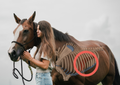
You dewormed. You booked the vet. You had the dentist out, twice. And the horse standing in front of you is still all ribs and topline you can hang a hat on. It is one of the most demoralising things in horse keeping, because you are doing everything right and the scale will not move.
Weight & muscle series
Read the other articles: Treating an underweight horse · Why is my horse too skinny? · Muscle growth
It is one of the most common questions vets field in winter. "My horse is too skinny, what am I missing?" Usually the answer is not more feed. It is something quieter, and it sits in the gut.
First, rule out the boring stuff (you probably already have)
Before any clever feeding strategy, the basics have to be clear. Parasite burden, sharp dental hooks that stop a horse chewing properly, pain, and chronic conditions like PPID (Cushing's) all cause weight loss that no bucket of mash will fix. If you have done a recent faecal egg count, a dental check, and a vet exam, good. You are further along than most.
But here is the part that frustrates people. A horse can pass all three checks and still drop condition. When that happens, the question changes. It is no longer "what do I feed?" It becomes "why isn't the feed turning into horse?"
Roughage is the foundation, and it is not optional
A 500 kg horse needs roughly 1.5 to 2% of its bodyweight in dry matter every day, most of it as forage [1]. That is 7.5 to 10 kg of hay dry matter for an average horse, and a hard keeper often needs the top of that range or more.
The reason is anatomical, not ideological. Horses evolved to trickle-feed for 16 or so hours a day, and the equine stomach secretes acid continuously whether there is food in it or not. Long gaps without forage mean acid splashing against an empty stomach wall. That is the express route to gastric ulcers, and an ulcerated horse rarely holds weight.
Example calculation
500 kg horse × 2% bodyweight = 10 kg dry matter/day in forage
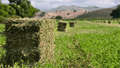
So the first move is unglamorous. Free-choice hay, decent quality, ideally tested for nutrient content. If your horse hoovers it up and is still thin, then you build from there.
When hay alone can't get there: mash and protein
Older horses with worn teeth, or any horse that physically cannot eat enough hay, benefit from a soaked mash. You want something high in fibre, low in sugar and starch, and easy to chew. The mash is there to add safe calories, not to replace forage.
Then there is protein, and this is where a lot of skinny horses are quietly let down. Weight gain is not just calories. To build topline and muscle rather than just fat, a horse needs the right amino acids, and lysine is the one usually described as first limiting in typical equine diets [2]. Worth knowing: the precise requirement has proved hard to pin down, and a controlled trial feeding yearlings graded amounts of lysine could not establish a clean breakpoint [2]. The practical lesson stands regardless. If the ration is thin on quality protein, adding energy alone will not build a topline. Alfalfa earns its place here: more protein and calcium than grass hay, and the calcium plus the act of chewing helps buffer stomach acid, which circles back to ulcer risk.
If the diet is calorie-adequate but the horse still looks weedy over the back, a targeted amino acid supplement does more than another scoop of grain. This is the gap Curafyt's Body&Build is designed to fill, feeding the building blocks for muscle rather than just energy. And if the base ration is short on vitamins and trace minerals, a balancer like ESTE Balancer covers that without piling on starch.
Adding energy without adding grain: the case for oil
Here is the objection that comes up constantly. "Horses can't digest oil, they don't have a gallbladder." Half true, and the half that is wrong matters.
Horses lack a gallbladder, yes. They still digest fat perfectly well, because the liver secretes bile continuously straight into the small intestine [3]. What they cannot handle is a huge slug of fat dumped in at once. Introduced gradually and split across meals, added oil is one of the most efficient ways to put condition on a hard keeper. Fat carries more than twice the energy of the same weight of carbohydrate, and crucially it lets you raise calories without raising the starch load that fuels ulcers and excitability.
The catch is which oil. A lot of people reach for whatever is cheap, and a lot of what is cheap (corn oil, sunflower oil) is heavy in omega-6. Horses on forage-based diets already skew that way, and a recent review of omega-3s in equine nutrition sets out why the balance between the two matters for inflammatory and metabolic processes, not just calorie supply [4]. This is where Grow&Glow is built differently: flaxseed oil for ALA, microalgae oil for DHA (a directly usable omega-3 the horse does not have to convert), coconut oil for medium-chain triglycerides, and natural vitamin E to keep the whole blend from oxidising.
Introduce oil slowly
Start with a small amount, split the daily dose across at least two meals, and build up over a couple of weeks. Rushing it can cause loose droppings and put the horse off the feed entirely.
The bit most people miss: the gut itself
This is the real answer for a lot of the horses people give up on. You can feed an immaculate ration and still lose the battle if the gut lining is inflamed and the hindgut microbiome is a mess. Damaged intestinal cells and a disrupted microbial population mean the horse simply does not extract what you are paying for.
The equine hindgut runs on microbial fermentation, and that community of microbes is doing a large share of the digestive work [5]. Guts&Glory takes a fuller approach: supporting the intestinal cells and gut barrier, supplying digestive enzymes, and rebalancing the microbiome with pre- and probiotics plus Saccharomyces yeast. The point is not to dump fish into a dirty pond. It is to clean the pond first.
"You don't have a feeding problem so much as an absorption problem." Fix the gut and the same ration suddenly starts working.Valerie, veterinarian, Curafyt
Putting it together
If you are staring at a thin horse this winter, the order matters. Clear the medical basics first. Get forage properly unlimited and decent quality. Add a low-sugar mash if teeth or intake are the limit. Cover protein and amino acids so the horse builds muscle, not just belly. Layer in the right oil for dense, low-starch calories. And take the gut seriously, because that is where most of the stubborn cases hide.
One more thing. Healthy weight gain is slow. Plan in months, not weeks. A horse that piles on weight in a fortnight is usually doing it in a way that lands you back at the vet.
Build your horse's condition from the gut up
The Grow&Glow and Guts&Glory combination targets calories and absorption together.
Shop horse supplementsScientific references
[1] National Research Council. Nutrient Requirements of Horses, 6th Revised Edition. Washington, DC: National Academies Press; 2007.
[2] Mastellar SL, Coleman RJ, Urschel KL. Controlled trial of whole body protein synthesis and plasma amino acid concentrations in yearling horses fed graded amounts of lysine. The Veterinary Journal. 2016;216:93-100. https://doi.org/10.1016/j.tvjl.2016.07.007
[3] Geor RJ, Harris PA, Coenen M (eds). Equine Applied and Clinical Nutrition. Saunders Elsevier; 2013.
[4] Bronś J, Czyż K, Wyrostek A, Smoliński J, Kruszyński W, Sokoła-Wysoczańska E, Dorobisz K. The Role of Omega-3 Fatty Acids in Horses' Nutrition: A Review. Animals. 2026;16(11):1626. https://doi.org/10.3390/ani16111626
[5] Julliand V, Grimm P. Horse species symposium: The microbiome of the horse hindgut. Journal of Animal Science. 2016;94(6):2262-2274. https://doi.org/10.2527/jas.2015-0198
Share