Does my horse have colic and what should I do?
 by Valerie De Clerck on Sep 21 2023· 7 min read
Key takeaways
- Recognise the behavioural signs of colic early enough to call the vet before it becomes an emergency.
- Understand the five types of colic, from a mild gas build-up to a life-threatening twisted gut.
- Know exactly what to do, and what to avoid, while you're waiting for the vet to arrive.
- Cut real colic risk through pasture time, constant water access, and slow feed transitions.
Colic is not a diagnosis: it is a symptom. It means abdominal pain, and in horses that pain can come from a dozen different causes. Some resolve on their own within the hour. Others turn life-threatening in that same window. Knowing which signs to look for, and what to do while you wait for the vet, changes outcomes.
Colic & digestion series
Read the other articles in this series: gastric ulcers in horses.
Signs that your horse has colic
Horses cannot vomit. That single anatomical fact means whatever goes wrong in the gut has nowhere to go but further along, or into crisis. So horses communicate distress through behaviour, and once you know what to look for, it is hard to miss.
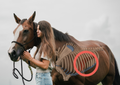
The most common signs I see in practice: restlessness, an inability to settle, pawing at the ground, repeatedly lying down and getting up. A horse that keeps looking back at its flanks, or turning its head toward its belly, is registering pain in that region. Rolling on the ground is a clear alarm signal. Sweating without any physical exertion behind it tells you the pain is significant. Any one of these warrants attention. More than one together, or any of them recurring over 20 to 30 minutes, means you call the vet.
The five types of colic
Not all colic is the same. The type determines urgency, treatment, and outcome.
Obstipation colic
A blockage in the large intestine, most often from impacted feed material. Too much dry hay without enough water is the classic scenario. Dental problems that prevent proper chewing are another route in: a horse that cannot grind its feed well enough produces material that is harder to pass. Annual teeth checks matter more than most owners realise.
Gas colic
Very common, especially in spring. When pasture grass grows rapidly, fructan levels rise sharply. Horses that graze that grass take in more fermentable carbohydrate than their hindgut microbiome can process smoothly, and the resulting fermentation produces gas faster than the gut can move it along. In one feeding trial, giving horses a moderate fructan dose measurably dropped hindgut pH and raised bacterial fermentation byproducts within hours [1]. The pain is real, but most cases resolve with medication and a bit of patience.
Spasmodic colic
Irregular, cramping contractions of the intestinal wall. A sudden change in diet is a common trigger, introducing a new hay batch without transitioning gradually, for instance. Worm burdens are another factor. The gut reacts, motility becomes erratic, and the horse shows intermittent, colicky pain. This is one of the reasons an appropriate deworming schedule is worth taking seriously.
Good to know
Changing a horse's hay type within a two-week window was linked to a nearly 30-fold jump in colic risk in one veterinary study, and repeated changes in hay or concentrate over a year roughly doubled it in another [2][3]. It is the strongest argument for the slow, boring feed transition described further down.
Sand colic
Horses grazing short, bare pasture inevitably ingest sand along with the grass. Over time, sand accumulates in the large colon, irritates the gut lining, and can cause both pain and disrupted motility. In a surgical case series of 40 horses with sand colic, most recovered, but ten also had a secondary colon displacement or twist alongside the sand impaction, a reminder that it rarely stays simple once it progresses [4]. The fix is partly management: providing extra hay so horses spend less time hoovering at the ground.
Displacement colic
This is the serious one. A portion of intestine shifts out of its normal position, twists, or becomes trapped. When the blood supply to that section is compromised, the tissue can begin to die within hours. Displacement colic does not respond to pain medication the way simpler colic does: the horse stays distressed, or deteriorates. Surgery is often the only option, and timing is critical. In one study of horses with a twisted large colon, roughly 77 percent survived the anaesthetic and just under half were still alive a year later [5]. This is why you never wait to see if a colic "sorts itself out."
What to do while you wait for the vet
Call first. Then, if the horse is alert enough and not at risk of injuring itself, walk it by hand at a quiet pace. Light movement can help with mild gas and spasmodic colic. It also keeps the horse from rolling violently, which in a displaced gut can make things worse.
Watch for manure. A horse that passes manure during or after a colic episode is a good sign: the gut is still moving. Note the time, the consistency, and whether the horse seems to improve afterward. Your vet will ask.
Do not give pain medication before the vet arrives unless you have been explicitly instructed to do so. Masking pain makes clinical assessment harder, and it can create a false impression that things are improving when they are not.
What to tell your vet
When you call: how long the signs have been going on, whether the horse has passed manure, its temperature if you can take it, heart rate if you know how, and any recent changes to feed, pasture access, or deworming. The more detail you give, the better the vet can triage over the phone.
Prevention: what actually reduces colic risk
Most of what reduces colic risk is management, not medication. Horses evolved to move and graze continuously, so 24-hour pasture access, where it is safe and feasible, is consistently linked to lower colic incidence than stabled horses on scheduled feeding [6]. Regular exercise supports gut motility. Fresh water available at all times is not optional: restricted access to water shows up again and again in colic risk research, and dehydration is a direct route to impaction [6].
Avoid sudden feed changes. When you need to transition to a new hay batch or introduce a new feed, spread it over at least 7 to 10 days. The gut microbiome needs time to adjust. During spring, when fructan levels in grass peak, consider restricting grazing in the early morning when levels are highest, or using a grazing muzzle for horses prone to digestive upset.
On short pasture, put out hay. It gives horses something to chew on that is not sand.
Supporting gut health between episodes
A well-functioning hindgut microbiome is the foundation of digestive resilience. In horses that have had repeated gas or spasmodic colic, or that are going through a period of stress or diet change, targeted digestive support can make a real difference to gut flora stability and motility.
Guts & Glory
A natural digestive supplement with pre- and probiotics to support a balanced gut flora and healthy motility in horses prone to digestive upset.
Keep your horse's gut in good shape
Browse our stomach and digestion range, developed with veterinary input and built around how horses actually work.
View digestion supplementsReferences
[1] Crawford C, Sepulveda MF, Elliott J, Harris PA, Bailey SR. Dietary fructan carbohydrate increases amine production in the equine large intestine: implications for pasture-associated laminitis. Journal of Animal Science. 2007;85(11):2949-2958. doi.org/10.2527/jas.2006-600
[2] Cohen ND, Gibbs PG, Woods AM. Dietary and other management factors associated with colic in horses. Journal of the American Veterinary Medical Association. 1999;215(1):53-60. pubmed.ncbi.nlm.nih.gov/10397066
[3] Tinker MK, White NA, Lessard P, et al. Prospective study of equine colic risk factors. Equine Veterinary Journal. 1997;29(6):454-458. pubmed.ncbi.nlm.nih.gov/9413718
[4] Ragle CA, Meagher DM, Lacroix CA, Honnas CM. Surgical treatment of sand colic: results in 40 horses. Veterinary Surgery. 1989;18(1):48-51. pubmed.ncbi.nlm.nih.gov/2929138
[5] Suthers JM, Pinchbeck GL, Proudman CJ, Archer DC. Survival of horses following strangulating large colon volvulus. Equine Veterinary Journal. 2013;45(2):219-223. pubmed.ncbi.nlm.nih.gov/22994687
[6] Curtis L, Burford JH, England GCW, Freeman SL. Risk factors for acute abdominal pain (colic) in the adult horse: a scoping review of risk factors, and a systematic review of the effect of management-related changes. PLOS ONE. 2019;14(7):e0219307. doi.org/10.1371/journal.pone.0219307
Share