











Home
›
Expert Horse Health & Wellbeing Advice
›
Coming In for Winter Looks Like the Safe Option. His Gut Disagrees.

Coming In for Winter Looks Like the Safe Option. His Gut Disagrees.
 by Valerie De Clerck on Oct 29 2026· 13 min read
Key takeaways
- Coming in for winter changes six things in a horse's gut at once (feeding pattern, water, throughput, forage type, bacterial population, and gut wall fuel), and it takes about two weeks to settle, with the first three days the most turbulent.
- Water intake almost triples when horses move from pasture to stable, so a slow or icy drinker is exactly where winter impactions start.
- Free faecal water has two established feeding-related causes worth checking: too much starch and too little fibre, and where a horse sits in the herd hierarchy.
- An hour of daily turnout meaningfully improves gut-relevant stress markers. Fifteen minutes doesn't.
Nothing dramatic happens on the day your horse comes in. The field gets muddy, the nights get cold, and one evening he sleeps inside instead of out. You've done it every autumn. He's fine.
What you changed that evening is not only where he sleeps. You changed how often he eats, how long he chews, how much water arrives with his feed, how fast food moves through him, what that food is made of, and which bacteria are there to ferment it. Six things, in one step, on the same evening. The gut is the organ that absorbs all of it.
It takes about two weeks to settle, and the first three days are the turbulent ones. Because six things moved at once, no single fix covers it. That's the part most winter advice skips.
Sound familiar?
- Every year at the changeover he gets loose droppings or faecal water, and every year you're washing his tail in the cold
- He came in, and within a fortnight there was a colic, or a scare, and nobody could tell you why
- He looks a bit dull and flat by December, and you can't put your finger on it
None of these are bad luck. They're the same event, showing up in different systems. Here is what that event actually is.
What changes in a horse's gut when he comes in for winter?
Six things, in the order the horse meets them.
First, the way food arrives. On grass he takes small mouthfuls for sixteen hours a day while walking. In a stable he gets a few large portions and stands still in between. Chewing time drops, saliva drops with it, and the gaps between meals get longer. You win some of that back with a knotless soft mesh haynet, hung low enough that he eats with his head down and high enough that a hoof can't get stuck in it.
Second, the water. Grass is roughly 80 percent water. Hay is not. Seven horses were monitored on pasture, then followed for two weeks after moving into stables (Williams et al., 2015). Their water intake almost tripled, from 2.4 to 6.4 litres per 100 kg per day, because a horse who used to eat his water now has to drink it. If the drinker is slow, or the trough has ice on it at six in the morning, that tripling doesn't happen, and that gap is where winter impactions live. Salt makes him drink, so hang a plain lick with no added minerals or vitamins. He should be able to take the salt he needs without swallowing extra trace elements with every lick, and selenium is the one that matters most, because the gap between enough and too much is small.
Third, the throughput. In the same study faecal output fell from 4.62 to 1.81 kg per 100 kg per day, less than half, and droppings went from 18.7 to 27.2 percent dry matter. Large colon motility dropped on day two, left colon on day four. Less material, drier, and a colon contracting less often to move it.
Fourth, the forage itself. Conserved forage is not grass with the water taken out. It has a different fermentable structure and a different nutrient profile, and the gut treats it as a new feed. Hindgut bacteria and volatile fatty acid production shifted significantly between two hays of near-identical analysis (Grimm et al., 2016). Grass to hay is a far bigger jump than that.
Fifth, the population doing the fermenting. Ten horses in New Zealand were sampled every month for a year, 118 faecal samples in all. In the months they grazed pasture alone, the diversity of their gut bacteria was significantly higher than in the months when hay was added (Fernandes et al., 2021). Diversity matters because a varied population covers more jobs at once: fermenting fibre into the volatile fatty acids that supply more than half of his maintenance energy, producing the butyrate that feeds the gut wall, and occupying the niche so an incoming pathogen has nowhere to settle. Healthy horses also carry a more diverse faecal microbiome than horses with colitis (Chaucheyras-Durand et al., 2022).
Sixth, the gut wall. The cells lining the colon run mainly on butyrate, which those same bacteria make from fibre. So the wall depends on the population for its own fuel, and when the population shrinks it has less to work with. That happens at the same time as everything else: drier contents, slower movement, and a new forage arriving in bigger, less frequent meals.
Six changes, arriving together. Each manageable on its own, awkward in combination. Which raises the obvious question: how long does the gut need?
How long does it take a horse to adjust to hay?
About two weeks, and the first three days carry most of it. When ponies were switched abruptly between grass and hay, most of the change in their faecal bacteria happened within three days, and individual bacterial groups were still measurably different at day fourteen (Garber et al., 2020).
That number matches the one vets use. A systematic review of colic risk factors found that a change in diet was the most commonly reported risk factor, with four separate studies naming a change in hay. A recent change in housing appeared in three studies, and in all three the risk window was two weeks or less (Curtis et al., 2019). The autumn move stacks both in the same fortnight, usually on the same evening.
So the fortnight is real, and it is where the two complaints owners actually bring to us belong. Start with the messier one.
Why does my horse get free faecal water when he comes in?
It shows up at the switch between grass and paddock, in both directions, and often clears on its own within days. When it doesn't, the search starts: sand, worms, teeth, ulcers, then a shelf of supplements with contradictory reviews.
The feed side has evidence behind it. A case-control study on 50 farms in Sweden and Norway compared horses with and without free faecal liquid. The affected horses were fed twice as much concentrate per 100 kg of bodyweight, with a significantly higher daily intake of starch and water-soluble carbohydrate, and significantly less neutral detergent fibre, straw and lucerne (Lindroth et al., 2021). More starch, less fibre. That is changes four and five above, in a clinical picture: starch that escapes the small intestine ferments in the hindgut, and the fibre fermenters lose ground. The authors are careful to say the differences were small, and they are right to.
Feed is not the whole answer. An earlier field study found no feeding factors at all, and found social ones instead. Forty percent of affected horses were last or second to last in the herd hierarchy, against 4 percent of controls, and 62 percent did not defend their food, against 27 percent (Kienzle et al., 2016). The two studies disagree, which is worth knowing before anyone sells you a single cause.
Both are cheap to check, so check both. Cut the concentrates, and give him more long fibre alongside his hay, straw or lucerne. Also add Este Balancer to provide the necessary vitamins and minerals without the extra sugars. Then watch him eat for ten minutes in his new group. If he's the one walking away from the pile, you have found the other half.
Does standing in a stable slow a horse's gut down?
Yes, and this is the one change of the six you can fix without buying anything. On pasture he moves nearly all day. In a stable he doesn't, and movement drives gut motility.
A 2026 crossover study of eleven horses tested 0, 15 and 60 minutes a day of turnout in twelve-day blocks. At 60 minutes, heart rate variability shifted towards parasympathetic tone and markers of immune stress including plasma IL-6 were lower than at 15 minutes. At 15 minutes the improvement was minimal (Rodgers et al., 2026). Fifteen minutes in the sand pen while you muck out doesn't count. An hour does.
Movement, feed and water are all things you set before he comes in. Which brings us to the ration.
How do you transition a horse from grass to hay?
Give the gut its two weeks. Mix the new hay into his field routine before he comes in full time and build it up over ten to fourteen days.
Keep the hard feed down and the long fibre up while you do it, for the reason the free faecal water study gives.
Add 250 grams of Este Balancer to your horse's feeding schedule. Good quality hay plus balancer is usually enough for recreational horses doing under 4 hours of intense work per week. This covers all the vitamins and minerals your horse needs. Only when your horse does more than 4 hours of work per week should you add concentrates to top up the calories. For every 1 kg of concentrates, decrease Este Balancer by 50 grams a day. You can also add Grow & Glow for horses that lose weight easily, it provides extra calories without the extra sugar. 100 ml a day for a 500 kg horse, divided over 2 meals a day.
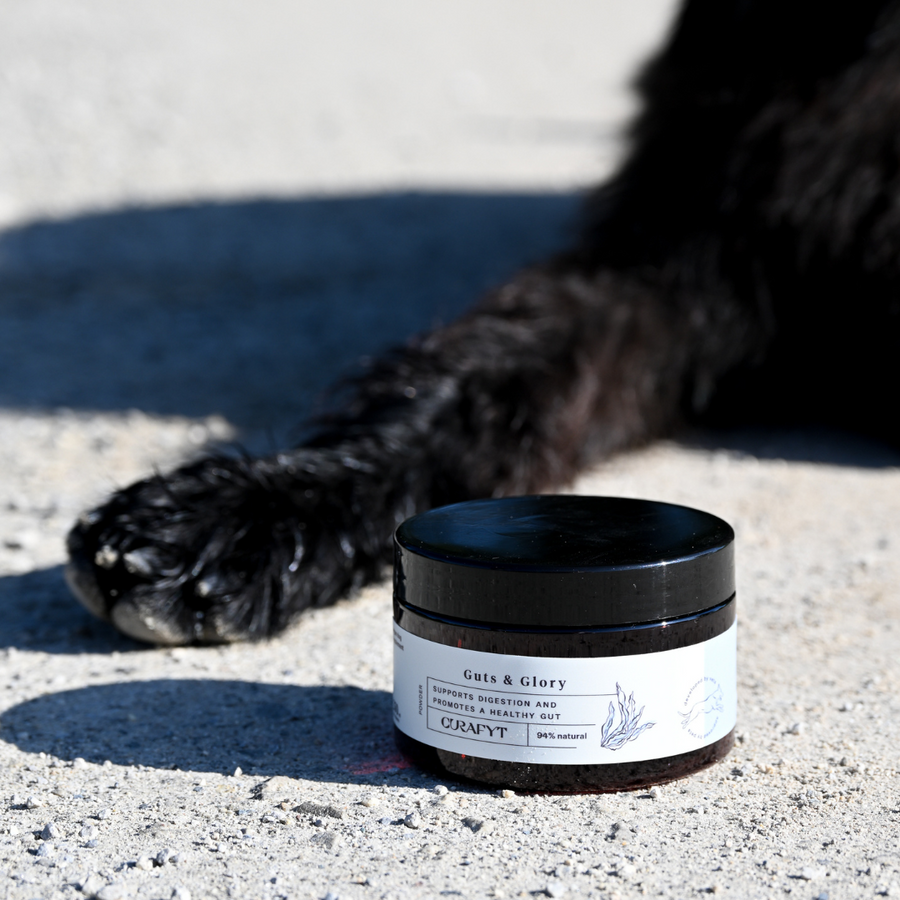
Add 15 grams of Guts & Glory daily to the food. This natural supplement works on 4 levels in the gut. Digestive enzymes and live yeast for a new forage arriving in fewer, larger meals. Five named live strains, each with its count on the pack, for the population that lost variety. L-glutamine, curcuma, zinc and MSM for the gut wall, which now has less butyrate to run on. Vitamins A, D3, E and C with zinc, selenium and spirulina for the mucosal immune layer.
Fresh grass is his main natural source of vitamin E and it doesn't survive conservation. If your horse is low in vitamin E, which you can check with a blood test, you can supplement extra vitamin E.
Este Balancer
Concentrated vitamins and minerals for horses transitioning off grass, without the extra sugars of a hard feed.
Guts & Glory
Four-level daily gut support: enzymes and live yeast, five named probiotic strains, L-glutamine and zinc for the gut wall, and vitamins for mucosal immunity.
Grow & Glow
Extra calories without the extra sugar, for horses that lose weight easily during the grass-to-hay transition.
Is it better to keep a horse out all winter?
Everything above could be read as an argument for leaving him in the field. It isn't. When 26 mares living out were scoped, 88 percent had squamous gastric ulcers of grade 2 or worse. After moving into individual stables with ad libitum hay, a low-starch feed and a settled routine, half had healed within four weeks and 13 of 14 had improved (Kranenburg et al., 2023). Out in the group, some mares were simply being kept off the forage.
Coming in is not the problem. Coming in badly is. And doing it well means more than one change.
Why one change to the ration isn't enough
More water does nothing for a population that has lost variety. A probiotic does nothing about droppings that just got nearly 50 percent drier. Cutting the hard feed helps the fermentation and leaves the water and the motility exactly where they were.
No single ingredient carries a six-part change on its own either. Live yeast alone did not prevent the microbial shift after an abrupt hay change (Grimm et al., 2016). What makes the difference is the combination: a gradual overlap, forage available for more hours, water he actually drinks, real movement, good forage with enough long fibre, and a supplement matched to what shifted.
Because the changeover rarely causes a problem by itself. It uses up the reserve that would have absorbed the next one.
Transition trouble, decoded
Colic is a veterinary emergency, whatever the season. Call your vet the same day.
For everything that isn't an emergency:
Loose droppings or faecal water at the changeover, every year? Predictable. Look at the starch-to-fibre balance first, and at where he sits in the herd second.
Any colic in the two weeks after coming in? Tell your vet exactly when he came in and when the hay changed. Both are recognised risk factors.
Flat and dull by midwinter? Look at what the ration lost rather than what it contains.
Your winter gut checklist
- Start the hay now, while he's still out. Ten to fourteen days of overlap, not one evening.
- Start the gut support before the move, not after the loose droppings.
- Cut the hard feed and add long fibre. Straw or lucerne alongside the hay.
- Test the water. Time the drinker, check it isn't icing, hang a spare bucket, and put up a plain salt lick.
- Hang a knotless haynet so he chews for longer instead of finishing his ration in two sittings.
- Book the turnout. An hour minimum, not fifteen minutes.
- Watch him eat in his new group. Ten minutes, once.
None of this is about keeping him out longer. The weather decides that. It's about giving a six-part change two weeks instead of one evening.
References
Chaucheyras-Durand, F., Sacy, A., Karges, K., & Apper, E. (2022). Gastro-intestinal microbiota in equines and its role in health and disease: The black box opens. Microorganisms, 10(12), 2517.
Curtis, L., Burford, J.H., England, G.C.W., & Freeman, S.L. (2019). Risk factors for acute abdominal pain (colic) in the adult horse. PLOS ONE, 14(7), e0219307.
Fernandes, K.A., Gee, E.K., Rogers, C.W., et al. (2021). Seasonal variation in the faecal microbiota of mature adult horses maintained on pasture in New Zealand. Animals, 11(8), 2300.
Garber, A., Hastie, P., McGuinness, D., Malarange, P., & Murray, J.-A. (2020). Abrupt dietary changes between grass and hay alter faecal microbiota of ponies. PLOS ONE, 15(8), e0237869.
Grimm, P., Julliand, V., Philippeau, C., & Sadet-Bourgeteau, S. (2016). Effect of yeast supplementation on hindgut microbiota and digestibility of horses subjected to an abrupt change of hays. Livestock Science, 186, 34-40.
Kienzle, E., Zehnder, C., Pfister, K., et al. (2016). Field study on risk factors for free fecal water in pleasure horses. Journal of Equine Veterinary Science, 44, 32-36.
Kranenburg, L.C., van der Poel, S.H., Warmelink, T.S., van Doorn, D.A., & van den Boom, R. (2023). Changes in management lead to improvement and healing of equine squamous gastric disease. Animals, 13(9), 1498.
Lindroth, K.M., Lindberg, J.E., Johansen, A., & Müller, C.E. (2021). Feeding and management of horses with and without free faecal liquid: A case-control study. Animals, 11(9), 2552.
Müller, C.E., Möller, J., Krogh Jensen, S., & Udén, P. (2007). Tocopherol and carotenoid levels in baled silage and haylage in relation to horse requirements. Animal Feed Science and Technology, 137(1-2), 182-197.
Pitel, M.O., McKenzie, E.C., Johns, J.L., & Stuart, R.L. (2020). Influence of specific management practices on blood selenium, vitamin E, and beta-carotene concentrations in horses. Journal of Veterinary Internal Medicine, 34(5), 2132-2141.
Rodgers, E.E., Yates, D.T., Parrish, B.L., & Luck, L.M. (2026). Sixty minutes of daily solitary turnout improved physiological and behavioral indicators of stress and welfare in stall-housed horses. Journal of Equine Veterinary Science, 166, 106075.
Williams, S., Horner, J., Orton, E., et al. (2015). Water intake, faecal output and intestinal motility in horses moved from pasture to a stabled management regime with controlled exercise. Equine Veterinary Journal, 47(1), 96-100.