











Home
›
Expert Dog Health & Wellbeing
›
The Great October Shed: What's Actually Normal (and What Isn't)

The Great October Shed: What's Actually Normal (and What Isn't)
Key takeaways
- A dramatic-looking blowout is hair that was already due to fall out.
- How much shedding you see depends heavily on coat type, so a Schnauzer and a Labrador simply shed differently.
- Diet does affect coat quality, but it works slowly and gently, so give it time.
- Patchy or one-sided hair loss, red or flaky skin, a coat that stops coming back, or a drop in energy or appetite alongside the shedding is worth a vet visit rather than a guess.
Your dog's coat runs on sunlight. It's been research-backed since 1977, when a year-long study of Beagles found shedding peaks tracked daylight, not cold snaps, and nobody's managed to overturn it since (Al-Bagdadi et al., 1977, American Journal of Veterinary Research).
You're brushing out a grocery bag of undercoat a week. The vacuum's clogging. You checked the calendar twice because you thought this was a spring thing. By the end of this, you'll know exactly what's driving it, and the handful of things that actually aren't just shedding.
Sound familiar?
- You're pulling a grocery bag's worth of undercoat out every week
- It's been going on for a month or two with no sign of slowing
- You assumed shedding season was already over for the year
If any of that's you, keep reading. None of it means something's gone wrong with your dog.
Blame the shorter days
Here's the part almost nobody gets told: your dog's hair follicles are reading the calendar through his eyes, not his skin. Light hits the retina, signals travel to the pineal gland, and the resulting melatonin shift tells follicles whether to grow or rest. Temperature plays a supporting role at best.
This isn't a new or shaky idea. It was demonstrated in Beagles back in 1977 and has been quietly confirmed ever since, most recently in a study that found the same daylight-driven pattern holds even in a tropical climate with barely any seasonal temperature swing at all (Favarato & Conceição, 2008). Nearly fifty years of researchers trying to poke holes in it, and the pattern just keeps holding.
Good to know
That dramatic-looking blowout is hair that was already finished and waiting to fall. It looks worse than it is.
Not every dog sheds the same amount, and that's fine
Here's a myth worth retiring: heavy shedding doesn't mean your dog's coat is somehow unhealthier than your neighbour's low-shedding dog. A comparative study found that at any given moment, an average of 93% of a Boxer's hairs are in the resting phase ready to shed, compared to 90% in Labradors and only 55% in Schnauzers (Favarato & Conceição, 2008).
The gap comes down to coat type. Wiry, curly coats simply cycle differently from short, dense ones, by design.
When it's more than shedding
Ordinary seasonal shedding comes with a normal dog attached to it: same appetite, same energy, same everything else, just more hair on the floor. A few signs point somewhere else:
- Patchy or one-sided hair loss, rather than an even thinning all over
- Red, flaky, or itchy skin underneath, not just bare skin
- A coat that stops coming back rather than cycling through and regrowing
- Any drop in energy, appetite, or general demeanour alongside the shedding
One or two of these alone often mean nothing. Several together, or a coat change without a matching "he's otherwise totally normal," is worth a vet visit rather than a guess.
Does diet actually help?
Yes, but not the way most supplement marketing implies. Hair is close to pure protein, and an actively growing follicle is one of the more metabolically demanding tissues in the body for its size. Feed it poorly for long enough and it shows.
Fatty acids are the most-studied lever here, and the honest picture is more nuanced than "just add fish oil." A recent feeding trial found that fish-oil supplementation clearly raised omega-3 levels in the blood within weeks, but coat quality scores hadn't visibly improved by six weeks in already reasonably-fed dogs (Cabrita et al., 2024). Blood chemistry moves fast. A visibly better coat is a slower, cumulative result of consistent nutrition.
Zinc is the other nutrient worth knowing about specifically, because a genuine gap shows up almost like a case study: in one small trial, four out of five dogs with a zinc-responsive skin condition improved with straightforward zinc supplementation (Lee et al., 2016). That's rare in dogs already eating a complete, balanced diet, but a real, well-documented mechanism when it does happen.
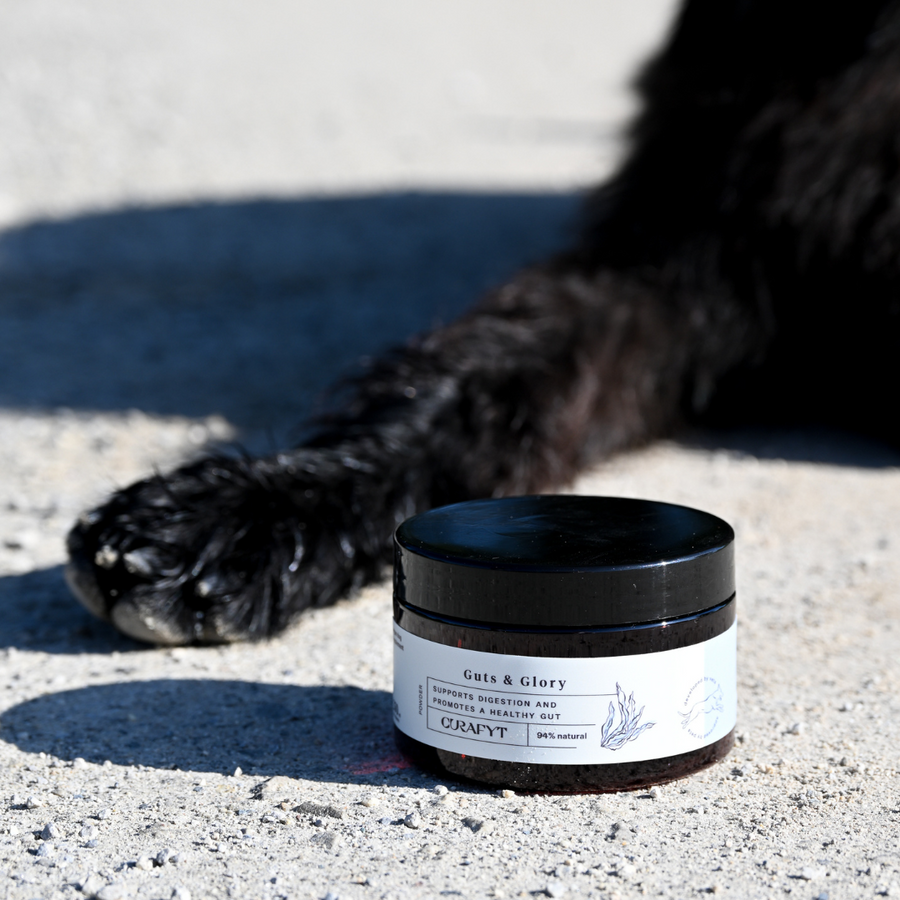
For a coat that's gone consistently dull, IMBY Multivitamin supports skin and coat condition with a daily nutritional baseline: vitamins, minerals, and amino acids, including zinc and DHA-rich algae oil, that support skin barrier function and coat structure from the inside.
Curafyt’s IMBY Multivitamin
A daily chew supporting skin barrier function, coat quality, and everyday vitality, built around zinc, DHA-rich algae oil, and a full nutritional baseline rather than one isolated ingredient.
If it's more itchy or dry than dull, Immune & Tune may be the better fit, alongside or instead of a general multivitamin. It's a plant-based omega-3 oil, with EPA and DHA from algae oil plus zinc, that supports skin comfort in dogs with itchy, dry or sensitive skin.
Neither one replaces a vet visit if something on the list above doesn't add up. Start with what you're actually seeing.
Your October coat checklist
- Check whether the shedding is even all over or patchy in spots. That distinction matters more than the volume.
- Look past the coat itself: same appetite, same energy, same everything else is the real "this is normal" signal.
- Give any dietary change a real runway. Blood levels shift within weeks, but a visibly better coat takes longer.
- If it's dull rather than dramatic, that's a nutrition-baseline problem before it's anything else.
Your dog is shedding because the days got shorter, exactly like they have every October for as long as dogs have had coats. Now you know why.
References
Al-Bagdadi FA, Titkemeyer CW, Lovell JE. (1977). Hair follicle cycle and shedding in male beagle dogs. American Journal of Veterinary Research, 38(5), 611-616.
Cabrita ARJ, Maia MRG, Alves AP, et al. (2024). Protein hydrolysate and oil from fish waste reveal potential as dog food ingredients. Frontiers in Veterinary Science, 11, 1372023.
Favarato ES, Conceição LG. (2008). Hair cycle in dogs with different hair types in a tropical region of Brazil. Veterinary Dermatology, 19(1), 15-20.
Lee FF, Bradley CW, Cain CL, White SD, Outerbridge CA, Murphy LA, Mauldin EA. (2016). Localized parakeratotic hyperkeratosis in sixteen Boston terrier dogs. Veterinary Dermatology, 27(5), 384-e96.
Share