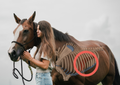


This is how your vet examines an infertile mare
 by Valerie De Clerck on Sep 21 2023· 7 min read
Key takeaways
- A fertility workup follows a set order, starting with breeding history and medical background before any hands-on exam begins.
- Body condition, lameness, and pain are often overlooked drivers of infertility since retained uterine fluid from reduced movement can lead directly to endometritis.
- Rectal ultrasound checks three things: endometrial texture, abnormal fluid in the uterus, and ovarian cysts that can disrupt cycling without any outward signs.
- Stable management, especially at least 16 hours of daily light plus correct feeding, can explain a failed season on its own, and additional diagnostics like culture, biopsy, or endoscopy are only needed when the earlier steps do not fully explain the picture.
When a mare fails to conceive, a structured examination gives the clearest picture of what is going wrong and what can realistically be fixed. Your vet will work through a defined protocol: start with the history you can provide, work through the clinical picture, assess the uterus and ovaries on ultrasound, then look at how the mare actually lives. Only after all of that will additional diagnostics be needed.
Mare & fertility series
Read the other articles: Why can't I get my mare in foal? · Examining an infertile mare
Step 1: History
The history is the foundation. Before examining the mare, your vet will want to know everything about her breeding background: how many seasons, which stallion or semen type, whether she conceived before and what happened, how many failed attempts this year. A mare who was fertile three years ago and suddenly isn't is a different clinical problem from one who has never held a pregnancy.
Medical history matters just as much. Previous illnesses, treatments, and especially orthopaedic issues come up more often than you might expect in infertility workups. A mare with a known history of laminitis or chronic pain is already flagging something that will come up again in the clinical examination.
Step 2: Clinical Examination
Your vet will start with the whole animal, not the reproductive tract. Body condition, coat quality, posture, whether the mare moves comfortably. Overweight mares are consistently less fertile in clinical practice. The mechanisms are not fully worked out, but the pattern holds up across the literature: mares maintained at a moderate body condition score cycle earlier in the year and need fewer cycles per conception than thin mares, while pushing condition past that range stops adding any benefit.[1]
Pain and lameness are underrated as causes of reproductive failure. A mare with active laminitis or significant lameness often cannot move enough to drain the uterus adequately between cycles, and reduced myometrial contractility is exactly the defect that has been documented in mares prone to persistent fluid accumulation.[2] That retained fluid is a direct route to endometritis. It is one of those connections that seems indirect until you have seen it a few times.
Then the reproductive tract specifically: are her seasons regular, or irregular and hard to detect? The vulva and vaginal conformation matter; a poor vulvar seal allows air and contamination into the uterus. A large retrospective study of nearly a thousand mares found fertility dropped from 67% in mares with normal conformation to 51% in those needing surgical correction, which is exactly why a Caslick procedure is worth doing early rather than after a season of failed covers.[3] The cervix should look healthy and appropriate for her cycle stage. Anything off there is significant.
Step 3: Rectal Ultrasound
Ultrasound reveals what cannot be seen or felt on external examination alone. Your vet will be looking at three things specifically.
Endometrial health
The texture and echogenicity of the endometrium changes with cycle stage, but pathological changes have a different character. Edema patterns, irregular thickening, abnormal echogenicity: these give the first indication of endometrial disease.
Fluid in the uterus
Free fluid in the uterine lumen outside of normal peri-ovulatory windows is abnormal. Even a small amount at the wrong stage of the cycle is a red flag for endometritis. The quantity and character of that fluid (anechoic versus echogenic) guides how aggressively treatment should proceed.
Ovarian cysts
Cysts on the ovaries can disrupt normal cyclicity and are easy to miss on external examination alone. Ultrasound is the only reliable way to find them. A mare who appears to be cycling but has a large anovulatory follicle or luteal cyst is not going to respond to standard breeding management: these structures can persist for three to seven weeks and produce near-normal progesterone levels, which is exactly why they get mistaken for a functional corpus luteum on a single scan.[4] That distinction matters more than most owners realise.
Fresh & Fertile Supplement
A supplement formulated to support uterine health and reproductive function in mares.
Step 4: Stable Management
This step is skipped more often than it should be. The mare's environment directly drives her reproductive function.
Photoperiod is the primary trigger for the breeding season. Mares need at least 16 hours of light per day to cycle normally, and a stable with poor natural light and no artificial lighting supplementation will push back the onset of cyclicity by weeks. Feed quality and quantity both matter: underfeeding delays or suppresses cycling, overfeeding creates the body condition problems mentioned above. Temperature and stress, including stabling conditions, social hierarchy, transport, and competition schedules, all layer on top of that.
Timing the light program
The original research behind this recommendation used roughly 100 lux, about what one 100-watt bulb gives a standard stall, and found it takes 60 to 70 days from the start of exposure to bring a winter-anestrous mare into her first ovulation of the season.[5] Start lighting in early December if you want a mare cycling by February. Starting in January is usually too late.
Some mares' infertility has been entirely explained by a dark stable and inadequate winter lighting. The fix costs nothing compared to a breeding season of AI attempts.
Step 5: Additional Diagnostics
After working through history, clinical examination, ultrasound, and management, your vet will usually have a working hypothesis. But sometimes the picture needs confirming, or the clinical examination points toward something specific that warrants a targeted test.
Bacteriological examination
If endometritis is suspected, a uterine swab or low-volume lavage gives a culture and sensitivity result. That is the difference between empirical treatment and targeted antibiotic selection. Treating endometritis without a culture result is a habit worth breaking.
Endometrial biopsy
A biopsy gives histology, specifically the degree of periglandular fibrosis, graded on the Kenney-Doig scale from I through III. That grade matters for prognosis: mares with minimal or focal fibrosis carry a good chance of carrying a foal to term, while diffuse, severe fibrosis puts the outlook in a different category entirely.[6] A mare with significant fibrotic changes has a fundamentally different reproductive outlook from one with acute, reversible endometritis. That information is worth having before committing to another expensive season of attempts.
Uterine endoscopy
Hysteroscopy lets the vet visualise the uterine lumen directly. Adhesions, cysts, structural abnormalities: these are things that can be missed on ultrasound and cannot be diagnosed from a swab. Your vet will reach for it when the other results do not fully explain the clinical picture.
Good to know
Not every infertile mare needs every test. The protocol works top-down: a thorough history and clinical examination resolves a significant proportion of cases before you ever reach for additional diagnostics. Start there, and let the findings drive what comes next.
References
[1] Morley SA, Murray JA. Effects of Body Condition Score on the Reproductive Physiology of the Broodmare: A Review. Journal of Equine Veterinary Science. 2014;34(7):842-853. doi.org/10.1016/j.jevs.2014.04.001
[2] Rigby SL, Barhoumi R, Burghardt RC, et al. Mares with Delayed Uterine Clearance Have an Intrinsic Defect in Myometrial Function. Biology of Reproduction. 2001;65(3):740-747. doi.org/10.1095/biolreprod65.3.740
[3] van Ittersum AR, van Buiten A. The prevention of pneumovagina and the effect of the Caslick operation on fertility: a retrospective study. Tijdschrift voor Diergeneeskunde. 1999;124(9):281-283.
[4] Ginther OJ, Gastal EL, Gastal MO, Beg MA. Incidence, endocrinology, vascularity, and morphology of hemorrhagic anovulatory follicles in mares. Journal of Equine Veterinary Science. 2007;27(3):130-139.
[5] Guillaume D, Duchamp G, Nagy P, Palmer E. Determination of minimum light treatment required for photostimulation of winter anoestrous mares. Journal of Reproduction and Fertility Supplement. 2000;(56):205-216.
[6] Westendorf J, Wobeser B, Epp T. IIB or not IIB, part 1: retrospective evaluation of Kenney-Doig categorization of equine endometrial biopsies at a veterinary diagnostic laboratory and comparison with published reports. Journal of Veterinary Diagnostic Investigation. 2022;34(2):206-214.
Supporting reproductive health in your mares
If you're working through a fertility protocol, targeted nutritional support can be part of a broader approach to uterine health. Browse the Curafyt fertility range for horses.
View fertility supplementsShare