


Home
›
Expert Horse Health & Wellbeing Advice
›
Equimove Balance Pads for horses: What are they and how do you use them

Equimove Balance Pads for horses: What are they and how do you use them
 by Valerie De Clerck on Oct 13 2025· 5 min read
Key takeaways
- Balance pads use an unstable, springy surface to force a horse's body into micro-adjustments, activating deep core muscles for balance and coordination.
- Equimove Balance Pads are made from high-quality closed-cell EVA foam, which stays waterproof, hygienic, and shock-absorbing without breaking down the way lower-grade foams do.
- Set your horse up for success first. Use a flat, non-slip surface, work with a helper on the lead rope, keep pads and hooves dry, and check with your vet if your horse has existing health issues.
- The eight-week training schedule builds gradually, starting with front legs for short intervals and progressing to all four legs for up to five minutes, improving balance, proprioception, and muscle control over time.
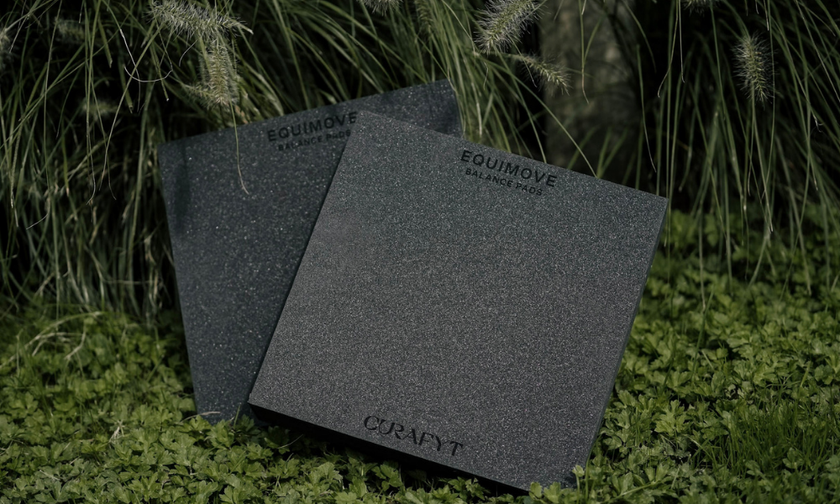
In our recent article on recognizing a weak core in horses, we introduced Equimove Balance Pads as a gentle, effective way to support core strength and stability. Today, we're diving deeper into what these pads are, how they work, and why they're such a useful tool for improving your horse's posture, proprioception, and overall well-being.
Here at Curafyt, we'd been searching for an effective way to support horses with a weak core for a long time. During that search, we turned to two leading veterinarians. Their input shaped the pad's design and the training approach behind it, resulting in balance pads that support your horse's long-term health, whether you compete or ride for pleasure.
What are balance pads for horses?
When your horse steps onto the firm, springy surface of a balance pad, a subtle yet powerful effect happens: the instability forces your horse's body to make micro-adjustments, activating deep core muscles to maintain balance and coordination [1][2].
It might look like a simple exercise, but it's a workout for the nervous system and core.
The result? A safe, effective way to strengthen stability, improve proprioception (the horse's sense of body awareness), and support relaxation, all without strenuous effort.
What the research shows
In a University of Georgia study, six Quarter Horses stood on firm balance pads for five minutes, twice a day, five days a week, for four weeks. By day 28, postural sway had dropped and the multifidus, one of the deepest stabilizing muscles along the spine, had grown in cross-sectional area at the fourteenth thoracic vertebra [2].
Can I use any foam pad for my horse?
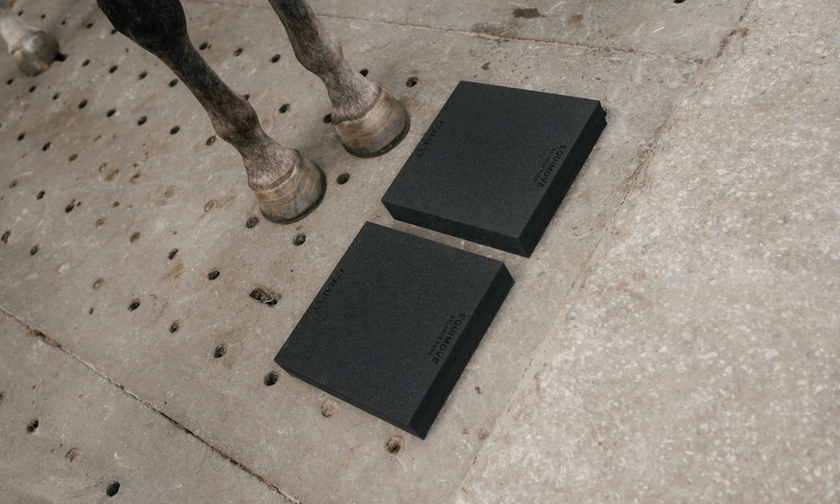
No. Not all balance pads are created equal. Our Equimove Balance Pads are made from high-quality closed-cell EVA foam. Unlike lower-grade open-cell or low-density foams that tend to compress unevenly, absorb moisture, and break down over time, EVA foam maintains its shape and integrity, even with repeated use by horses.
They're waterproof and hygienic, absorb shock and vibration to protect joints, and maintain their shape even after repeated use. Lightweight yet strong, they're built to safely support a horse's full weight, making them a reliable tool for consistent, long-term training.
How to use Equimove Balance Pads
Whether you're aiming for top performance, rehabbing after injury (always loop in your vet first), or simply adding variety to groundwork, using balance pads is simple.
Unlike strenuous workouts, balance pads work passively. Your horse simply stands on them, and their body does the rest, making subtle corrections that engage deep muscle groups.
To set your horse up for success, it's important to follow these instructions before you begin:
- Ground surface: Choose a flat, non-slip surface such as a stable aisle or grooming area.
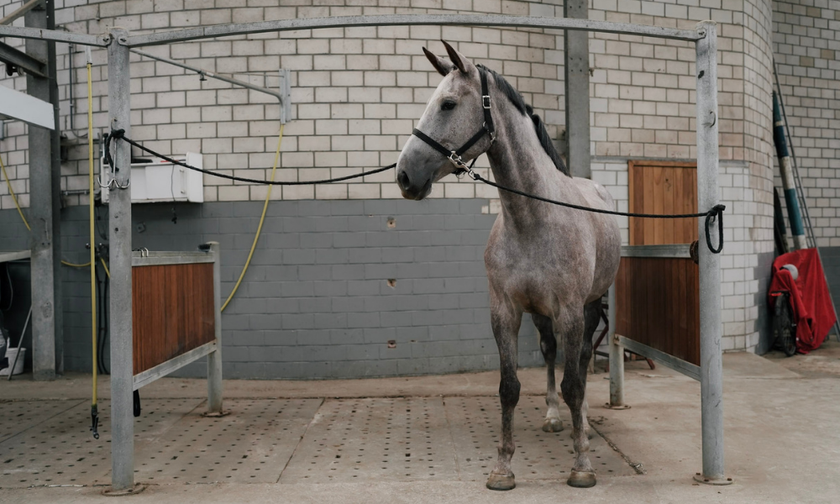
- Helper & Handling: Work with a helper holding the lead rope. Never tie or leave your horse unattended on the pads.
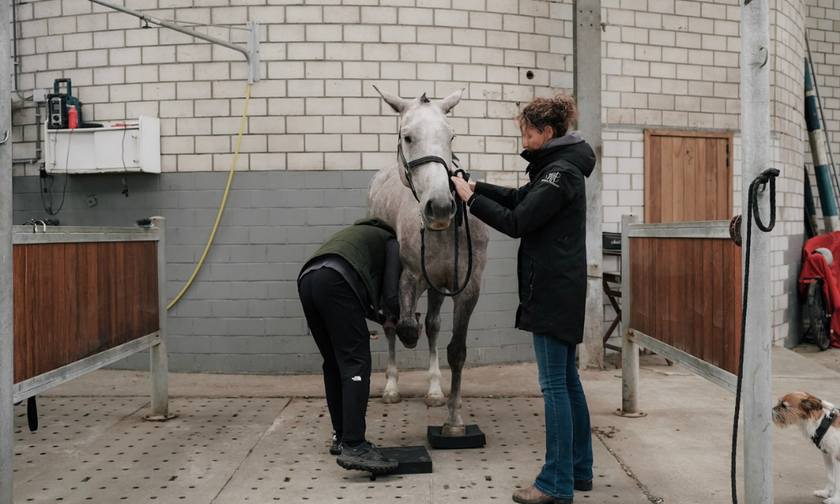
- Getting used to the pads: Start slow, some horses need time to get comfortable. Calmness and trust matter more than standing perfectly still.
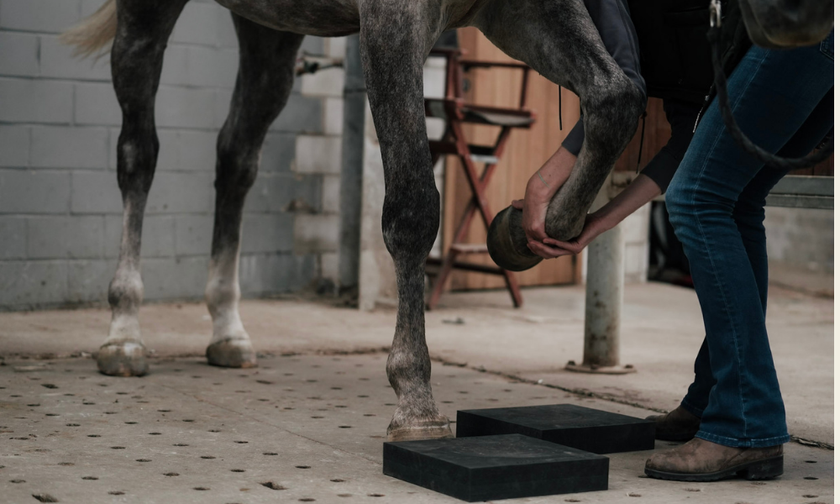
- Hoof preparation: Only use dry pads with dry hooves. File sharp hoof edges if barefoot and be mindful with shod horses.
- Veterinary check: If your horse has existing health issues, check in with your veterinarian first.
Pro tip: Before starting, take clear photos of the back, neck, and pelvic line. Comparing after 4 and 8 weeks, you'll see subtle, yet noticeable differences.
A step-by-step 8-week balance pad training schedule
You might be wondering: how do I start my horse's training with the balance pads? We created a simple and easy to follow eight-week schedule to get you started:
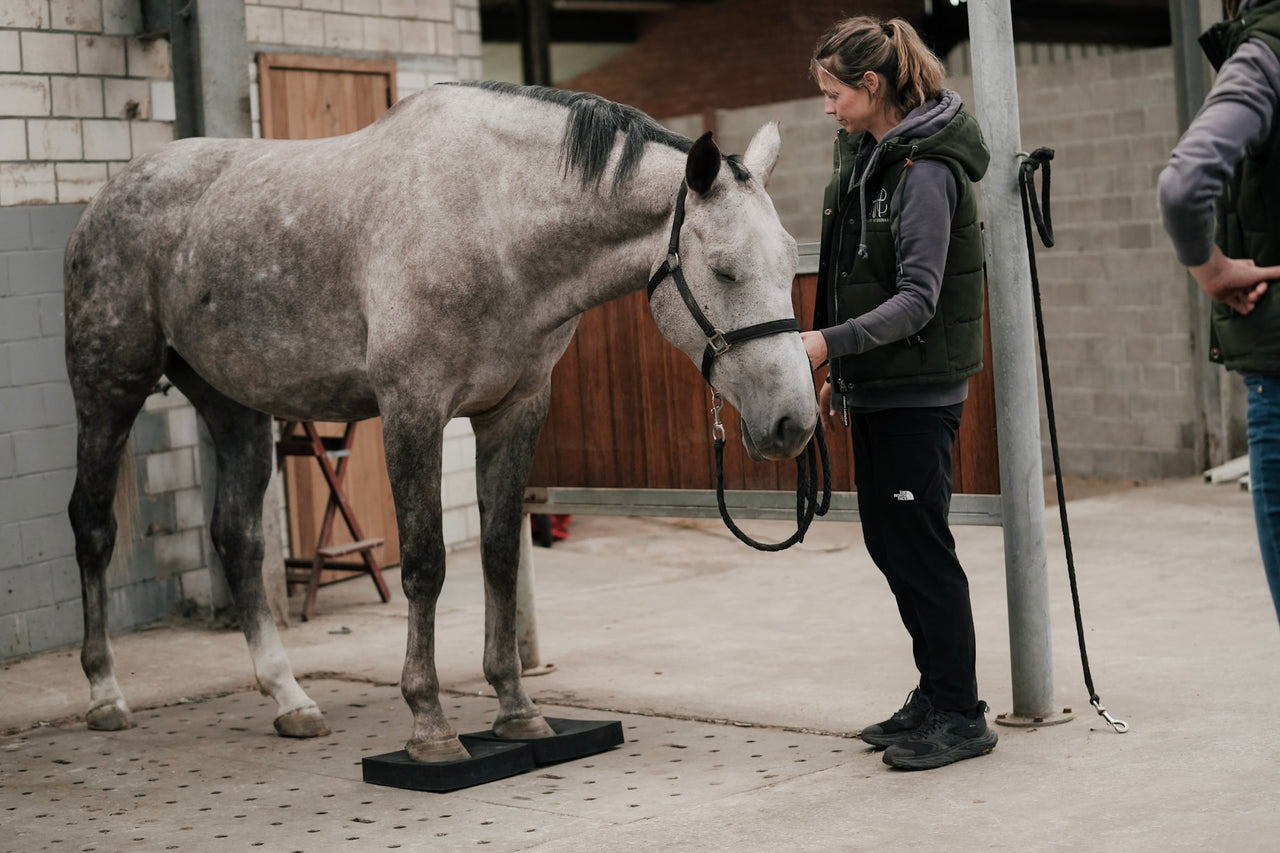
Week 1-2: Getting used to the pads
- Create trust and calmness on the pads.
- Exercise: 2 front legs on the balance pads, 1 hoof per pad.
- Time: Start with 30 seconds, building up to 2 minutes maximum.
Week 3-4: Building duration
- Stimulation of muscle endurance and controlled balance.
- Exercise: 2 front legs on the balance pads.
- Time: Build from 2 to 3 to 4 minutes.
Week 5-6: Deeper activation
- Hold for longer.
- Exercise: 2 front legs on the balance pads.
- Time: Build up to 5 minutes.
- Variation: small breaks in between are fine, for example 2 x 2.5 minutes.
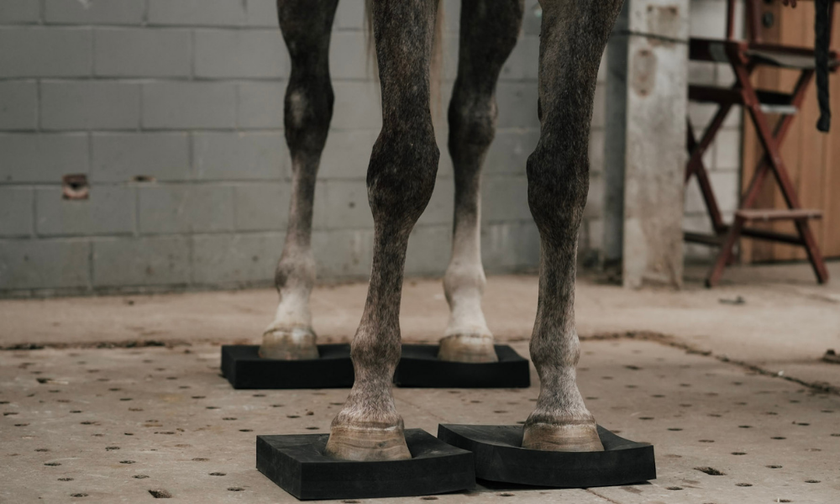
Week 7-8: Activating full body posture
- Extension to 4 legs for maximum core stability.
- Week 7: Start with 2 front legs on balance pads, then add the hind legs.
- Week 8: 4 legs on balance pads.
- Time: 5 minutes maximum.
Just like any form of training, progression lies in consistency. Over the course of eight weeks, you'll gradually increase time on the pads and the difficulty, leading to better balance, increased proprioception, and more muscle control.
Pro tip: Through each stage, look for calm breathing, symmetry, and relaxation. Those are the signs the exercise is doing its job.
Conclusion
Balance pads are more than a simple training tool, they are a way to support your horse's long-term health, comfort, and performance. By combining balance pads with knowledge about core strength, proprioception, and pain recognition, you will be equipped with the knowledge to help keep your horse in peak condition.
Ready to start your horse's balance training?
Equimove Balance Pads are the vet-developed pads behind the eight-week schedule above, made from closed-cell EVA foam built to handle a horse's full weight, day after day.
Shop Equimove Balance PadsReferences
[1] Colla S, King M. Evaluation of postural sway in horses standing on balance pads of varying densities and limb placement. Journal of Equine Rehabilitation. 2025;3. Read study
[2] Cathcart J, Ellis K, Moorman V. Short term use of balance pads on postural sway and musculus multifidus cross-sectional area in horses. Journal of Equine Rehabilitation. 2024. Read study
Share