Home
›
Expert Horse Health & Wellbeing Advice
›
What is proprioception in horses and how to improve it

What is proprioception in horses and how to improve it
 by Valerie De Clerck on Oct 13 2025· 4 min read
Key takeaways
- Proprioception is your horse's built-in awareness of where its body is in space, and it relies on receptors in the muscles, tendons, and joints sending signals to the brain.
- Weak proprioception can show up as tripping, poor coordination, an unstable posture at rest, or difficulty standing square, so a simple self check can flag horses that may need support.
- Strong proprioception improves performance and lowers injury risk by giving the body faster feedback and control, and it is closely tied to core strength.
- The Equimove Balance Pad, co-created by veterinarians Elien and Mounia, challenges a horse to make continuous micro adjustments, and just a few minutes before riding or lunging a few times a week can build stability and confidence over time.
Proprioception might sound like a complicated word, but at its core it simply means a body's awareness of where it is in space. Think of it as your horse's built-in balance system, the one that helps them place each hoof exactly where it needs to go. When proprioception is weak, horses may trip more often, struggle with coordination, or be more prone to injury.
The good news is that proprioception can be trained. Do it consistently and your horse's movement, confidence, and long-term wellbeing improve along with it.
What is proprioception and why is it important?
Proprioception is often called the body's "sixth sense." It's the awareness of where the body is in space without relying on sight. Specialized receptors in the muscles, tendons, and joints send constant signals to the brain, and the brain uses that information to make tiny corrections that keep the body balanced and coordinated.
Good proprioception in your horse can present itself as:
- Accurate hoof placement on uneven surfaces
- Quick, stable reactions during sudden movements
- Body control that reduces the risk of injury
- Confident and smooth performance under the saddle
For horses, this sense is vital. It lets them place their hooves accurately, stay upright during quick maneuvers, and react instantly to a slip. Strong proprioception does not just improve performance. It also lowers injury risk by giving the body faster feedback and control [1].
Is my horse showing signs of poor proprioception?
So how do you know if your horse could benefit from proprioception training? We put together a short self-check. Circle whatever applies to your horse.
- Posture at rest: hollow/flat/rounded back
- Topline: visible/well-covered
- Standing square: difficult/easy
- Transitions: unbalanced/stiff/smooth
- Behavior when saddling/grooming: resistant/sensitive/calm
If you circled one or more of the first options above, that can be a sign your horse's proprioception is lacking. Check with your vet first, since some of these signs can come from other issues entirely.
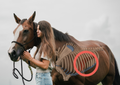
Core strength is another good place to look. Horses with a weak core often compensate with the same unbalanced movements, and that compensation is often the earliest warning sign that proprioception is starting to slip.
Not sure whether a weak core is an issue for your horse? Our guide on recognizing weak core muscles and how to strengthen them walks through what to look for.
How can I improve my horse's proprioception?
One of the most effective, and surprisingly simple, tools for this is the Equimove Balance Pad, co-created by veterinarians Elien and Mounia from Equimove. It's built to challenge your horse's body into continuous micro-adjustments. Do that consistently and you strengthen stabilizing muscles, improve joint flexibility, and sharpen proprioceptive awareness over time.
What the research shows
In a four-week trial, horses stood on balance pads for five minutes, twice a day, five days a week. By week four, their multifidus muscle (one of the deep muscles that stabilizes the spine) had grown measurably larger, and their postural sway while standing on the pads had dropped [2].
You don't need long or complicated sessions to see this kind of change. Less than a minute a day, increased slowly week by week, is enough to notice a difference.
It's not glamorous work. Standing your horse on a squishy pad for under a minute does not look like training, but the muscle response backs it up.
Want a clear roadmap? We built a practical 8-week schedule that shows exactly how to introduce and build up Balance Pad training, step by step.
After the eight weeks, you'll likely notice your horse standing and moving with better posture. The deep core muscles built over those weeks are what hold that stability in place.
Keep using the pads afterward as part of your horse's routine. The best time is before riding or lunging, not after: tired muscles can't hold posture well, so training on fatigued muscles does less. A few minutes before work, a few times a week, is enough to keep your horse supple, stable, and confident over time.
Conclusion
Improving your horse's proprioception does not just enhance performance. It builds a stronger foundation for long-term strength and confidence. With consistent exercise, your horse can become more balanced, agile, and resilient, whether that means a quiet hack around the field or a class at a show.
Paying attention to these small details in training makes a real difference to your horse's comfort, safety, and overall wellbeing.
Give your horse's balance a head start
The Equimove Balance Pad is the tool this whole article is built around: vet-developed, simple to introduce, and linked to a measurable increase in core muscle size after four weeks of daily use.
Shop Balance PadsReferences
[1] Colla, S., & King, M. (2025). Evaluation of postural sway in horses standing on balance pads of varying densities and limb placement. Journal of Equine Rehabilitation. sciencedirect.com/science/article/pii/S2949905425000246
[2] Cathcart, J., Ellis, K., & Moorman, V. (2024). Short term use of balance pads on postural sway and musculus multifidus cross sectional area in horses. Journal of Equine Rehabilitation. sciencedirect.com/science/article/pii/S294990542400001X
Share